


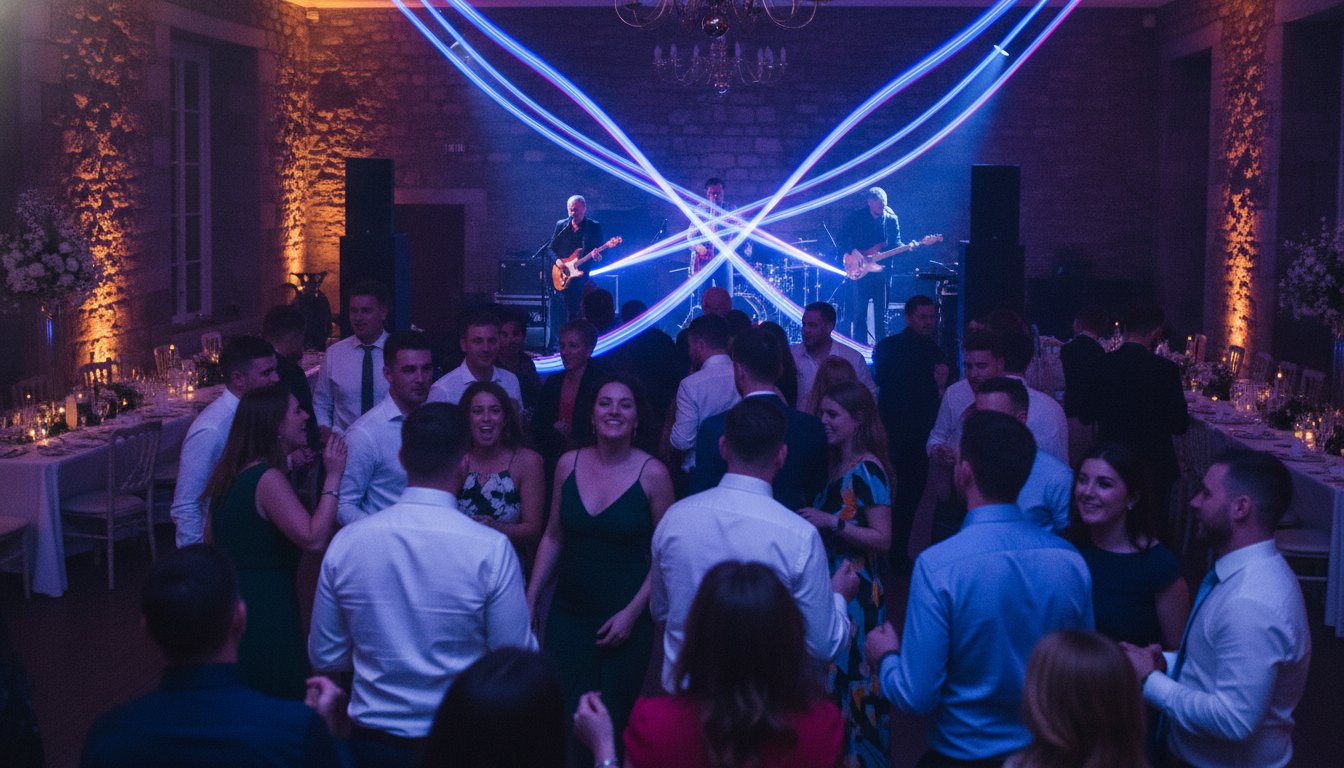
18 Jun How to Transition from Dinner Music to Dancing: The Ultimate 2026 Wedding Guide
The greatest threat to your wedding reception isn’t a rainy forecast or a late caterer; it’s the dreaded post-dessert “food coma” that leaves guests glued to their chairs. You’ve spent months planning a legendary celebration, yet the most critical moment is often the most overlooked: learning how to transition from dinner music to dancing without losing a single guest to the hotel lobby. It’s a high-stakes vibe shift that requires more than just a volume boost.
We know you want a dance floor that’s packed from the first beat until the final late-night DJ set. It’s frustrating to watch your crowd disperse during a room turnaround or fade away during an awkward silence. This guide will show you how to master that transition with professional timing, sensory cues, and high-energy live music strategies. We’ll explore the bridge events that physically pull people to the floor and the technical execution needed to keep the momentum soaring through 2026 and beyond.
Key Takeaways
- Identify the critical 45-minute transition window. Learn to defeat the guest inertia that threatens to stall your party after the final course.
- Master how to transition from dinner music to dancing using tactical cues like the cake cutting to physically move your crowd.
- Use sensory shifts in sound and lighting to create an immersive floor. These professional cues signal the shift from conversation to celebration.
- Stop the lobby migration during your venue’s room turnaround. Keep guests engaged and excited while the stage is set for the main event.
- See how a high-octane Band & DJ Package provides atmosphere insurance. Ensure your energy never dips from the first dance to the late-night DJ set.
What is the Dinner-to-Dancing Transition (And Why It Fails)?
Every legendary performance needs a bridge. In the context of Elements of a Wedding Reception, that bridge is the “Transition Window.” This is the critical 45-minute gap between the final bite of dessert and the first note of live music. If you haven’t mastered how to transition from dinner music to dancing, this window becomes a black hole for energy. Guests don’t just wait; they wander. They check their phones. They look for the exit.
Biology is often the party’s biggest enemy. After a heavy three-course meal, the human body naturally craves a chair and a quiet corner. This is Guest Inertia. It’s a real, physiological response. Without a tactical vibe shift, your guests will slip into a “food coma” that no amount of late-night snacks can fix. When the lights stay low and the music remains ambient, you’re essentially sending a sleep signal to the entire room.
Beware the Bar Trap. When the energy dips, guests migrate to the bar for a fresh round. If that bar is in a separate room or a quiet lobby, you’ve lost them. They get comfortable. They start long conversations. They miss the “call to action” that officially starts the party. By the time the band starts, you’re playing to an empty floor while the real crowd is a hundred feet away, settled into a sofa.
The 2026 standard for wedding entertainment has moved beyond simple playlists. It’s about a total sensory overhaul. We’re talking about a deliberate shift from ambient background noise to a high-octane performance that commands the room. It’s the difference between a party that just happens and a party that truly arrives with intent and energy.
The Anatomy of the After-Dinner Lull
Heavy catering and dim lighting are powerful sleep signals. They tell your older guests it’s time to head home. Dead air during a band setup is the ultimate momentum killer. It creates a psychological void that guests fill by leaving. You need to identify these momentum killers in your timeline early. Don’t let your schedule dictate the energy; let the energy dictate the schedule. Every second of silence is an invitation for someone to call a taxi.
Setting the Stage During the Meal
The build-up starts long before the first dance. Your choice of drinks reception music sets the energetic baseline for the entire day. By the time the final course is served, your MC should ditch the formal, “official” tone. Switch to a high-octane, celebratory delivery. Bump the background volume by a few decibels as coffee is served. This subtle change “wakes up” the room. It builds anticipation. It signals to your guests that the formal portion of the evening is over and the real celebration is about to begin.
The 5-Step Tactical Timeline for a Seamless Party Launch
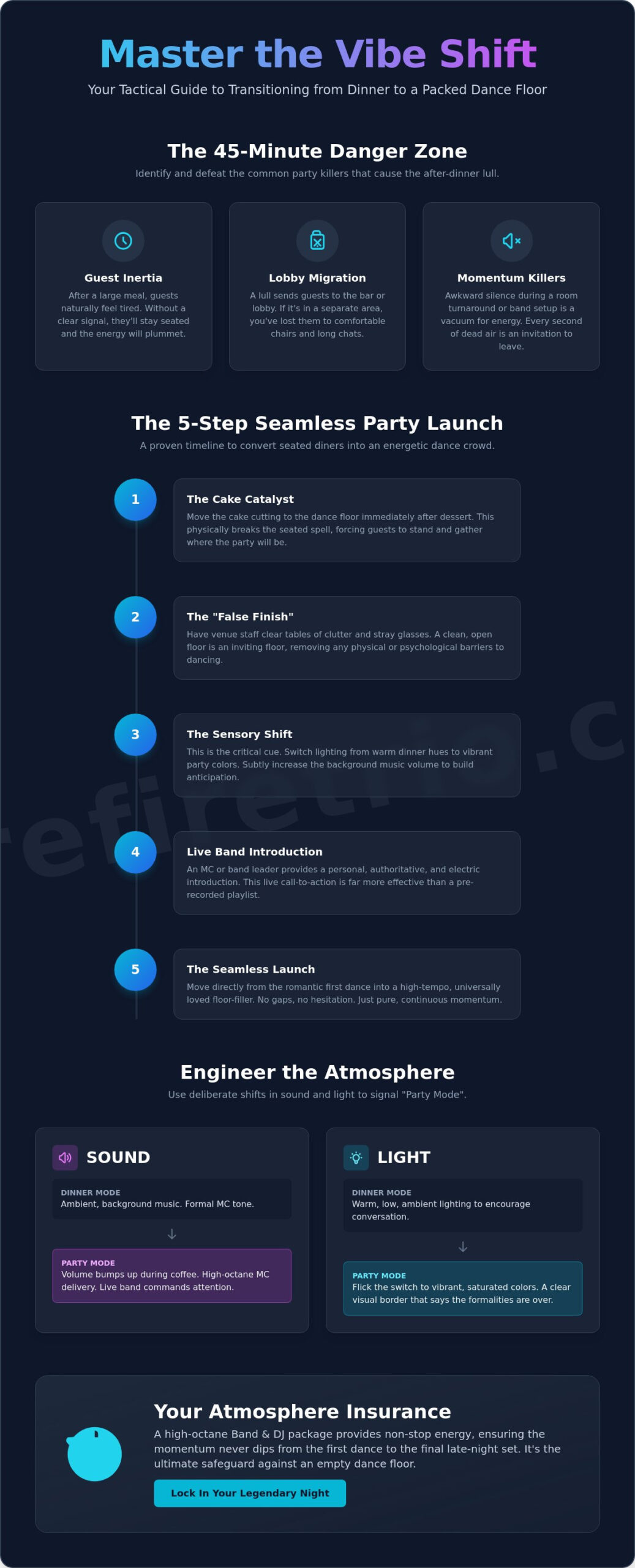
Executing a flawless party start isn’t about luck; it’s about strategy. Knowing how to transition from dinner music to dancing requires a series of deliberate triggers. These moments tap into the science of how music shapes our social identities, turning a room of seated diners into a collective, high-energy crowd. Here is the blueprint for a perfect launch.
First, use the cake cutting as a “stand up” signal. By moving this tradition to the center of the dance floor, you physically break the seated spell. It forces every guest to rise, gather, and focus on the stage. Next comes the “False Finish.” This is where venue staff clear the tables of clutter and stray glasses. A clean floor is an inviting floor. You want zero friction between your guests and the music.
Step three is the sensory shift. Flick the switch from warm dinner hues to vibrant, saturated party colors. This visual border tells the brain that the formal dinner is officially over. The fourth step belongs to the band leader. A live professional introduction bridges the gap better than any pre-recorded playlist ever could. It’s personal. It’s authoritative. It’s electric. Finally, the launch. You move from the romantic slow dance directly into a high-tempo floor-filler. No gaps. Just pure momentum.
The Cake Cutting as a Momentum Tool
Don’t hide the cake in a corner. Move it to the dance floor immediately after dessert. This forces guests to stand and gather in the very spot you want them to stay. Use an energetic “Cake Song” as your first musical hook of the evening. It’s a call to action that signals the party has arrived. Cutting the cake right before the first dance ensures that guests are already on their feet and ready to move, creating a perfect opportunity for professional shots like those seen at ianpetriesphotography.co.uk/portraits.
The First Dance: From Romantic to Rocking
Choosing the right first dance song is crucial for setting the pace. Look for a track that allows for a natural tempo build. A great band knows the “Invitation to Join” moment. It’s that precise second where we call guests to flood the floor and surround the couple. Follow the “Three-Song Rule.” The first ten minutes of the set determine the energy for the next three hours. If you want a night that stays high-octane, consider booking a Band & DJ Package that guarantees a seamless flow from the first note to the final encore.
Sensory Shifts: Using Sound and Light to Signal ‘Party Mode’
Atmosphere isn’t an accident; it’s a technical achievement. Mastering how to transition from dinner music to dancing requires a deep understanding of sensory psychology. You aren’t just changing the song. You’re changing the state of the room. By the time the final plates are cleared, your guests should feel a physical shift in the environment that pulls them toward the stage. This is where the “vibe shift” becomes a reality.
The audio threshold is your first tool. You can’t just crank the volume. That’s jarring. Instead, you move from “background” decibels to “immersion” levels. Dinner music lives in the mid-range frequencies, allowing for easy conversation. Dance music lives in the low-end. Professional trios use pre-recorded “bridge” tracks to camouflage the final technical checks during the band setup. This ensures there is never a second of silence. Silence is the enemy of momentum. It reminds people they are tired. A seamless audio bridge keeps the energy alive while the band prepares to take the stage.
Visuals in 2026 have evolved. We’re seeing a massive departure from sterile “white light” setups. Modern weddings favor immersive, color-washed dance floors that use saturated hues to shrink the room. High-energy uplighting creates a visual border. It turns the dance floor into a safe, inviting “island” where guests feel less exposed. When the rest of the room is draped in shadow and the floor is alive with texture, the psychological barrier to dancing vanishes.
The Science of Frequency and Energy
The kick drum is the biological signal to start moving. While dinner tracks are vocal-heavy and melodic, your dance set must be rhythm-heavy. Low-end frequencies resonate in the chest, triggering a subconscious urge to stand. You’re shifting the focus from the lyrics to the beat. Acoustic Saturation is defined as the precise moment music evolves from a background layer into the room’s singular, undeniable focus. Once you hit this point, the conversation ends and the celebration begins.
Lighting as a Psychological Barrier
Kill the house lights. It’s the single most important move for guest confidence. Bright lights make people self-conscious. Darkness, punctuated by moving heads and rhythmic textures, provides anonymity. Use light to “pull” guests from the bar. Dynamic lighting on the stage creates a sense of performance that demands attention. When the stage looks like a concert, guests treat it like one. They don’t just watch; they participate. This visual “call to action” is what keeps the floor packed from the first note of the Band & DJ Package until the early hours of the morning.
Defeating the ‘Room Turnaround’ Lull
Many Irish venues require a “room turnaround.” This is the 30-minute window where staff frantically rearrange tables to reveal the dance floor. It’s a logistical necessity that often becomes a party killer. If you want to know how to transition from dinner music to dancing successfully, you must conquer this specific gap. While the band manages the music, the venue must manage the physical safety of this rapid changeover; for more on professional workplace safety and training, you can learn more about Guardian Safety. Without a strategy, your guests will fall victim to “Lobby Migration.” They check into their hotel rooms. They linger at a quiet bar. Some might even decide it’s a good time to head home. You cannot afford to let the thread of the celebration snap during this interval.
You need to maintain the momentum with tactical speed. A professional trio offers a massive “Quick-Set” advantage here. Unlike a sprawling orchestra with endless gear and complex soundboards, an agile trio sets up with surgical precision. Minimal footprint means faster transitions. You aren’t leaving your guests in a silent foyer for an hour while the crew hauls in heavy speakers. You’re getting them back into the main room while the adrenaline is still high. Speed is the ultimate defense against a fading atmosphere.
The ‘Foyer Strategy’ for Guest Retention
Keep the energy alive in the transition space. Don’t let the music stop just because the main room is being flipped. Move the energy to the bar or foyer with a bridge performance. A solo set or a lively duo keeps guests engaged while the main stage is prepared. Clear communication is your best friend during this phase. Your MC should make a definitive announcement about the “next act” to build anticipation rather than confusion. Professional wedding planning must account for these venue flip times to ensure the celebration never feels disjointed or stalled.
The Seamless Band-to-DJ Handoff
Momentum is a fragile thing. The best way to protect it is through a combined Band & DJ package. This setup eliminates the “dead air” associated with equipment swaps and separate vendor arrivals. When the band finishes their final, high-energy encore, the DJ should be ready to drop the first beat of the next set instantly. This is the “Zero-Gap” transition. It keeps the energy at a peak. The party doesn’t reset; it simply evolves into its next high-octane phase. Ensure your night stays electric by booking a professional Band & DJ Package that manages the flow from the first dance to the final late-night anthem.
Why Surefire Trio is Your ‘Atmosphere Insurance’ for 2026
You have the blueprint for a legendary night. Now you need the engine to drive it. Surefire Trio acts as your “atmosphere insurance,” protecting the energy of your celebration when the stakes are highest. We’ve spent years perfecting how to transition from dinner music to dancing for couples across Ireland. Our approach is designed to eliminate the risks of a quiet floor or a disjointed evening. We don’t just provide a service; we act as active partners in your party’s success.
The power of the trio lies in our agility. A massive twelve-piece orchestra is impressive, but it’s often slow to deploy. Our compact footprint allows for lightning-fast transitions during those critical room turnarounds we discussed earlier. We provide a high-energy sound that fills the largest ballrooms without the logistical bloat. This is authentic live music. We never use backing tracks. It’s raw, infectious energy that commands guest attention from the very first chord. When you hear us play, you feel the difference that real, unfiltered performance brings to the room.
Our integrated Band & DJ package is the ultimate full-night solution. By managing the entire evening, we ensure the momentum never drops. There is no handoff to a stranger at midnight. Instead, the same team that built the energy during the live set maintains it through the late-night DJ set. We also provide expert MC guidance. We aren’t just musicians; we are vibe managers. We read the room, adjust the tempo, and steer the “vibe shift” from start to finish.
A Tailored Approach to Your Dance Floor
Your celebration shouldn’t sound like everyone else’s. We offer customized First Dance Song performances that set the perfect tone for your specific story. Our repertoire is a carefully curated journey through the 70s, 80s, and 90s. We know exactly which anthems bridge the generational gap. Whether we’re performing in the historic halls of a country estate or a modern city boutique hotel, our experience across Ireland’s top wedding venues ensures a flawless technical execution every time.
Booking Your Peace of Mind
In the high-stakes world of wedding planning, atmosphere insurance is your most important investment. You can have the best catering and the most beautiful flowers, but guests remember how they felt on the dance floor. The Surefire Trio promise is simple: a packed floor from the first song until the final encore. We take the stress out of the logistics so you can stay in the moment. Don’t leave your party’s success to chance. Secure your 2026 wedding date with Surefire Trio today!
Own the Night: Your Seamless Path to a Packed Dance Floor
You have the tactics. You have the timeline. Now it’s time to execute. Mastering how to transition from dinner music to dancing is about more than just hitting “play” on a loud track. It’s about using sensory triggers, tactical bridge events, and the raw energy of live performance to keep guest inertia at bay. By controlling the room turnaround and using light as a psychological signal, you ensure the energy never dips. The party doesn’t just happen; it’s built with precision.
We bring authentic 100% live sound to every stage with zero backing tracks. With five-star reviews from real Irish weddings and nationwide coverage across Ireland, we guarantee the expert management your big day deserves. Don’t let your party’s momentum fade during the dessert lull or the room flip. We act as your partners to keep the floor electric from start to finish.
Check availability for your 2026 wedding and get a quote for our Band & DJ package. Let’s make your wedding the high-octane celebration it was meant to be. We can’t wait to see you on the floor.
Frequently Asked Questions
How long should the transition from dinner to dancing actually take?
The active transition window should ideally take no more than 45 minutes from the final dessert bite to the first dance. Learning how to transition from dinner music to dancing effectively means minimizing this gap to prevent “lobby migration.” A tight timeline ensures your guests stay focused on the celebration. We prioritize speed and momentum to keep the energy from dipping during the room’s final reset.
What should the band play while guests are finishing their dessert?
The music should shift from low-key background tracks to mid-tempo “bridge” songs as dessert is served. We use these tracks to subtly raise the energy levels before the live set begins. It signals that the formal dining is ending and the party is approaching. Think upbeat soul or classic pop that encourages foot-tapping without overpowering the final conversations of the meal.
Is it better to have the speeches before or after the meal for better energy?
Speeches before the meal generally preserve more energy for the dance floor. Guests are hungry and attentive at the start of the reception. If you wait until after a three-course meal, the “food coma” makes it harder to re-engage the room. Getting the formalities out of the way early clears the path for an uninterrupted party that builds momentum toward the first dance.
Can a live band manage the transition as well as a DJ?
A professional live band is uniquely equipped to manage this high-stakes shift. Live performers offer a charismatic, physical presence that a digital playlist simply can’t match. When we show you how to transition from dinner music to dancing, we use the raw energy of live instruments to command the room’s attention. It’s about more than just volume; it’s about a visual and emotional call to the floor.
How do we keep guests on the dance floor if the bar is in a different room?
You must create a “sensory island” on the dance floor that is more attractive than a quiet bar. Use dynamic lighting and high-octane live music to pull focus back to the stage. We also suggest having the MC make regular, high-energy calls to the floor. This ensures the bar crowd feels the pulse of the party and doesn’t feel disconnected from the main event.
What happens to the music during the ‘room turnaround’ in Irish venues?
Music should never stop during a room turnaround, even if the main room is being flipped. We use a secondary sound system or a “bridge” set in the foyer to keep the atmosphere alive. This prevents the “lobby migration” where guests drift off to their hotel rooms. Maintaining a continuous audio thread is vital for guest retention and ensures the party energy stays high.
Should the first dance be a slow song or a fast one to start the party?
A slow First Dance Song that transitions into a high-tempo floor-filler is the gold standard for 2026. This gives you the romantic moment you want while providing a launchpad for the rest of the guests. We specialize in these tempo-builds to ensure the floor is flooded the second your dance ends. It turns a private moment into a collective, high-energy celebration instantly.
How does the Band & DJ package handle the transition at midnight?
Our Band & DJ Package is designed for a seamless, zero-gap handoff at midnight. The DJ starts the next track exactly as the band finishes their final encore. This eliminates the awkward silence of equipment swaps. It keeps the high-octane energy flowing directly into the Late-night DJ set, ensuring your guests never have a reason to leave the floor as the night reaches its peak.
Sorry, the comment form is closed at this time.