


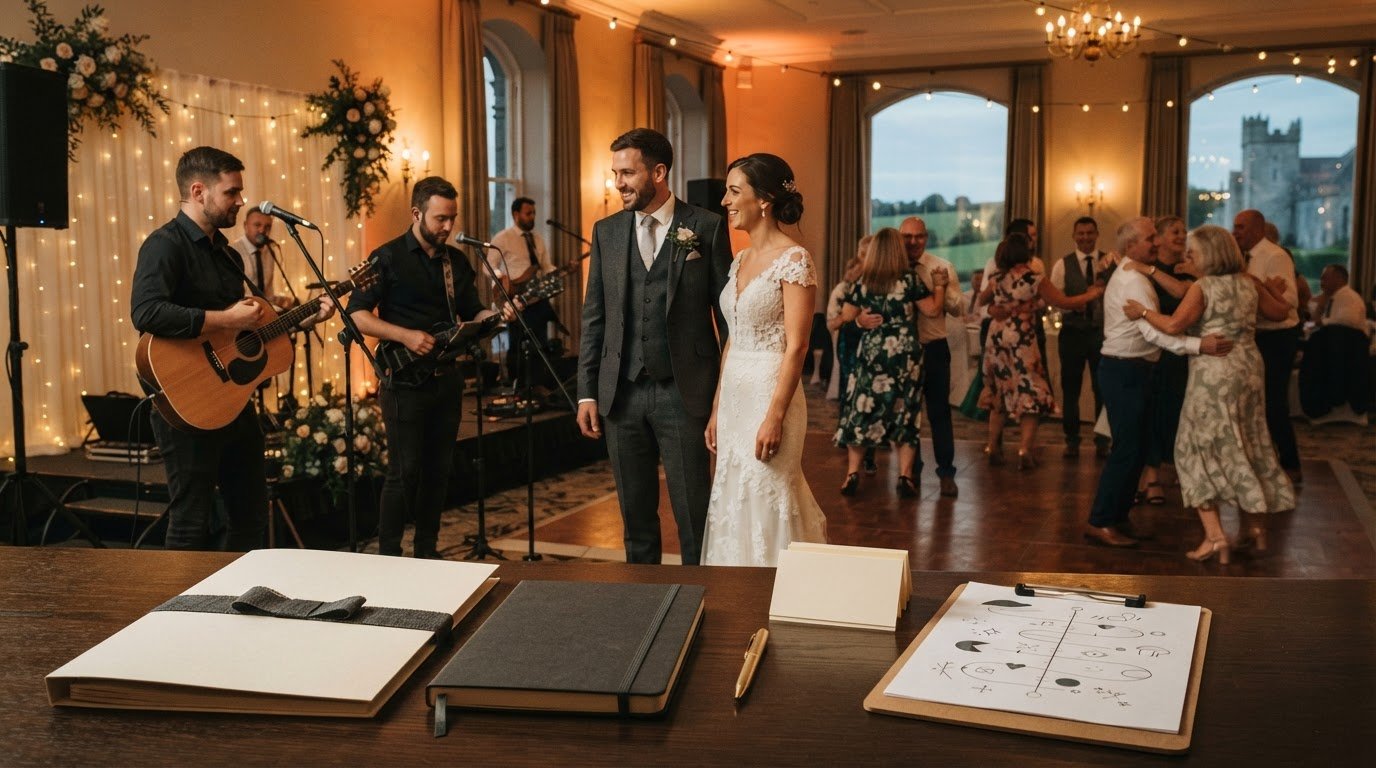
29 Sep How to Brief Your Wedding Band: A Clear Guide for 2026
What if the best wedding-band brief isn’t a long list of songs, but a clear sense of what matters most? If you’re wondering how to brief your wedding band, it’s understandable to worry that too little detail could mean missed moments, while too many instructions might leave the musicians no room to read the crowd. The sweet spot is a shared vision, not a script.
A useful brief gives the band your musical preferences, highlights the moments that matter and covers practical details that help the reception run smoothly. It also leaves room for live performers to respond to the guests and build the energy as the night unfolds.
This guide explains what to include, from must-play and do-not-play songs to your first dance, timings, venue logistics and announcements. You’ll learn how to set clear priorities without micromanaging the performance, so your band understands the atmosphere you want. Clear brief. Room to dance.
Key Takeaways
- Learn how to brief your wedding band with clear priorities that guide the atmosphere without scripting every moment.
- Bring essential event facts together, including confirmed timings, venue contact details and access or setup information.
- Use a short, prioritised list of song requests to show what matters most while leaving room for the band to read the crowd.
- Confirm the schedule, announcements and band-to-DJ handover so everyone knows what’s fixed and where flexibility remains.
- Review one organised brief before sharing it, and mark open questions so they can be clarified ahead of the day.
Why briefing your wedding band helps your reception feel like you
A great reception doesn’t need a song-by-song script. It needs a shared sense of what matters. If you’re unsure how to brief your wedding band, you’re not alone. Too little direction can leave important preferences unclear, while an overly detailed list can make it harder for performers to adapt. A useful brief avoids both extremes.
A band brief records your musical priorities, event facts and flexibility boundaries. It gives the musicians a clear picture of the atmosphere you want and the moments you’d like handled with care, while leaving them room to respond to the guests in front of them. Think of it as a compass, not a set of stage directions.
What a wedding-band brief should, and should not, do
Use the brief as a concise reference for preferences, confirmed timings and essential information. It should show what’s non-negotiable and where the band has creative freedom. Naming your first-dance song and a few tracks you’d love to hear is helpful. Specifying every song in order or scripting every transition can make it harder to adapt if the room’s energy shifts.
Live musicians can notice when guests are ready to dance, when they need a breather or when a familiar chorus might bring different generations together. Your guidance shapes the performance; it doesn’t need to replace the band’s judgement.
Start with the feeling you want guests to remember
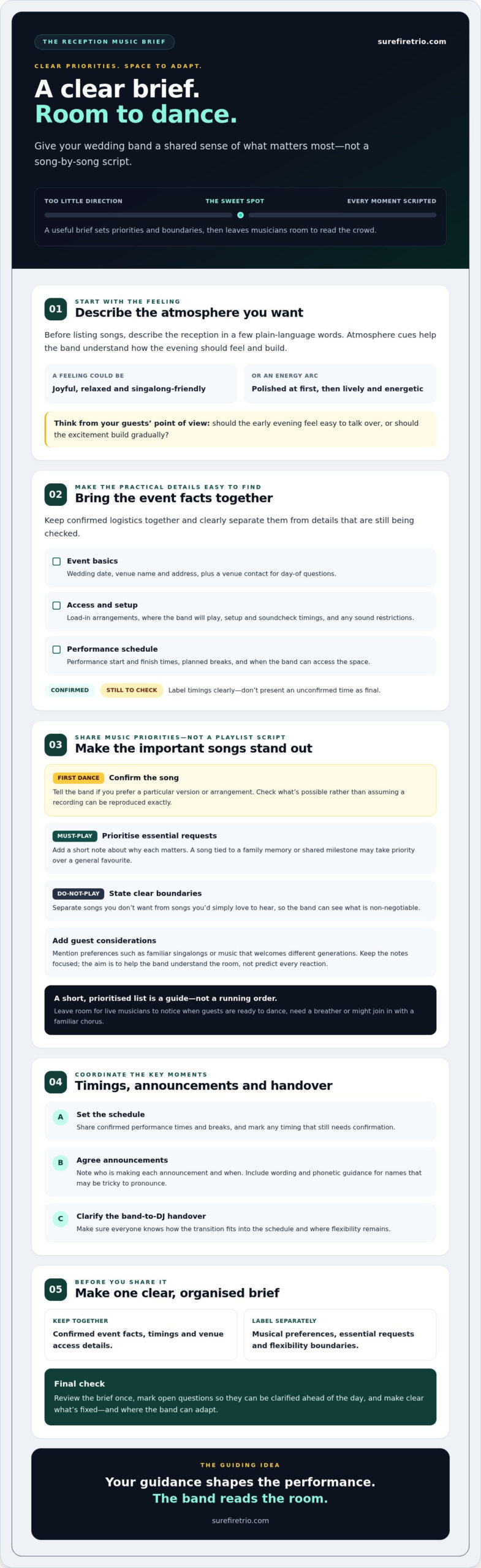
Before choosing individual songs, describe the reception in a few plain-language words. Maybe you want it to feel joyful, relaxed and singalong-friendly, or polished at first, then lively and energetic. Those cues communicate more than a genre label alone. They suggest how quickly the music should build, how familiar the songs might be and how much guest participation you’re hoping for.
Picture the experience from your guests’ point of view. Should the early part of the evening feel easy to talk over? Do you want people dancing quickly, or should the excitement build gradually? A broad overview of the types of wedding music can help you think about how music serves different parts of a wedding, from ceremony moments to the reception.
For wider planning context, see this wedding planning guide for Ireland. Then bring your focus back to the reception: choose a few priorities, explain why they matter and give the band room to make the room come alive.
What information to give your wedding band before the big day
A clear brief should be easy to scan, especially when the band needs to check a detail quickly. Keep essential facts together and label preferences separately, so there’s no confusion between a confirmed schedule and a musical suggestion. This is the practical side of how to brief your wedding band: share enough for the musicians to prepare without burying key details in a long email thread.
Event details and timings the band needs
Start with the wedding date, venue name and address, plus a venue contact who can help with day-of questions. Set out the expected performance schedule, including when the band can access the space, setup and soundcheck timings, performance start and finish times, and any planned breaks. If a time is still being confirmed, label it clearly rather than presenting it as final.
Ask the venue and band to confirm access and setup arrangements, such as where performers should load in, where they’ll play and whether there are sound restrictions the band should know about. Record what’s agreed and flag anything that still needs checking. The Knot offers a useful list of questions to ask a wedding band to help you clarify details with your entertainment provider.
Note who’s making announcements and when. If the band is expected to introduce the couple or announce a special moment, include the wording and phonetic guidance for any names that could be tricky to pronounce. These small details can help an important moment feel natural, not uncertain.
Musical preferences, first dance and special moments
List essential song requests and add a short note about why each matters. A song tied to a family memory or shared milestone may deserve a higher priority than a general favourite. For your first dance, confirm the song and tell the band in advance if you have a preferred version or arrangement. Check what’s possible with the performers rather than assuming every recording can be reproduced exactly.
Include guest considerations that could shape the atmosphere, such as a preference for familiar singalongs or music that welcomes different generations. Keep these notes focused. The aim is to help the band understand the people in the room, not to predict every reaction.
Checklist: separate confirmed event facts, such as timings and venue access, from optional musical preferences, such as favourite genres and extra song requests.
If ceremony music is part of your plans, explore wedding ceremony performance ideas and note any choices the band needs to discuss with you. Surefire Trio offers ceremony singing and ukulele duos for drinks receptions, alongside its evening entertainment. Couples considering live music alongside a DJ can also see how Surefire Trio’s wedding music options might fit their plans.
How to share song requests without turning the night into a playlist
Song requests are most useful when they show the band what matters, not dictate every track of the night. A long, unranked playlist can blur the difference between a song that means everything to you and one that simply fits a mood. If you’re working out how to brief your wedding band, sort requests into clear priorities and explain where the musicians have room to choose.
Must-play songs, do-not-play songs and flexible preferences
A must-play is a priority, while a reference track describes a direction. Mark only the songs you’d be disappointed to miss as essential, and add a brief note about their significance. One might be tied to a family memory; another could be the track that always gets your friends singing. That context helps the band understand why each request matters.
A do-not-play list is just as useful when it’s focused. Name songs or styles you genuinely want avoided, rather than ruling out anything you don’t personally love. Then use broader preferences to guide the rest: genres, decades or energy levels can point the band towards your taste without demanding an exact sequence.
- Must play: essential songs, with a short note on why they matter.
- Do not play: specific tracks or styles you want the band to avoid.
- Flexible preferences: genres, eras or moods that capture the sound you enjoy.
Share these categories with the band and ask how they handle requests alongside their own set choices. The Knot’s guide to essential questions for your wedding band can help you clarify expectations around song requests and performance style.
Build a shared picture of the dancefloor
Help the band picture your guests without reducing them to assumptions. You might mention that the room includes several generations, that friends love a big singalong, or that some guests would appreciate space to move comfortably around the dancefloor. If cultural or accessibility considerations could affect song choices or how the room feels, explain what would help rather than expecting the band to guess.
Reference tracks can make your preferences easier to interpret. Choose a few examples that capture the feel you want, then say what they have in common: perhaps a lively rhythm, a familiar chorus or a particular era. The band can use that direction to shape a set that feels connected, not copied. For more inspiration, browse this wedding party songs guide, then select only the ideas that genuinely sound like you.
Keep the list focused. Your requests should give the band a clear starting point, while leaving the live performance room to build momentum and respond to the dancefloor.
Agreeing Timings, Announcements and Band-to-DJ Handover
Clear timings don’t make a reception feel over-rehearsed. They prevent avoidable uncertainty from interrupting the fun. Distinguish the confirmed event timeline, such as a scheduled first dance or finish time, from the flexible performance sequence, where the band can adjust songs and pacing to suit the room. As you decide how to brief your wedding band, agree on the important markers, then give the performers room to bring the evening to life.
Confirm the running order and key announcements
Use this simple process to align the couple, band and whoever is coordinating the day:
- Step 1: Share the latest schedule. Include the expected start and finish of the band’s performance, key moments and planned announcements. Mark timings that may shift, rather than treating estimates as fixed.
- Step 2: Assign announcement responsibilities. Confirm which introductions or reminders the band should make, and who will provide the wording. Write down names phonetically if pronunciation needs care.
- Step 3: Choose one contact for updates. Give the band a clear day-of contact who can pass on changes. This avoids conflicting instructions reaching performers from several people.
Decide how updates will be shared, too. A change to the first-dance timing may affect the set; a small delay elsewhere might not. Agree who makes that call and how the band will hear about it. Keep the plan practical, not rigid. The schedule protects the important moments, while the route between them can stay flexible.
Plan a smooth live-band and DJ transition
Confirm when the live set is expected to finish and when the DJ set should begin. Then agree who coordinates the handover and whether it needs an announcement or a particular song to bridge the change. If the timing might move, name the person who will confirm the revised cue. This helps avoid a pause, overlap or uncertainty about who is taking over.
Music can shape the mood across the full celebration, not just the dancefloor. If you’re planning entertainment earlier in the day, this drinks reception music guide offers ideas for carrying a welcoming atmosphere into the evening.
Think of your agreed cues as signposts, not a script. A planned first dance and a clear live-to-DJ handover give everyone confidence; the band can still adjust the performance sequence to match the crowd. If you’re considering live music alongside a DJ, explore Surefire Trio’s Band & DJ Package and discuss how the handover can fit your schedule.
How to send your final wedding-band brief and keep the conversation easy
You’ve gathered the important details. Now make them easy to use. A single, well-organised document gives the band one clear reference instead of scattered notes across emails and messages. It also makes it easier to see what’s settled and what still needs a conversation.
Use a one-page brief the band can act on
Keep the layout simple and put the most time-sensitive information first. A practical order is:
- Event facts: date, venue details, timings, access notes and the day-of contact.
- Key moments: confirmed cues, announcements and any special song choices.
- Music priorities: must-play and do-not-play requests, followed by flexible genre or mood preferences.
- Open questions: details that need confirmation, clearly marked so nobody mistakes an assumption for an agreement.
Before sending, check that the timings match the latest schedule, names and announcement wording are accurate, and duplicate requests have been removed. Keep essential instructions distinct from optional ideas. If a venue detail or performance cue is undecided, label it as a question and note who will confirm it.
Send the final version to the contact you’ve agreed with the band. Ask them to confirm receipt and flag anything that needs clarification. If an important detail changes later, share an updated copy and make clear what has changed, rather than sending a correction that could get separated from the original brief.
Make room for the professionals to read the room
Before you sign off, identify which choices are fixed and where the band can adapt. Your first dance or a song with real personal meaning may be a firm priority; the order and pace of other tracks can often stay flexible. That balance respects your preferences while letting live performers respond to guests and keep the night moving.
A clear brief isn’t a demand for a flawless, pre-scripted performance. It’s a useful starting point for a conversation. If you’re still deciding how to brief your wedding band, ask the musicians how they prefer to receive updates and which parts of the plan they may need to discuss with you.
For couples planning celebrations across Ireland, Surefire Trio offers wedding-band performances alongside professional DJ sets. You can talk with Surefire Trio about your wedding music and discuss whether its live music and DJ offering suits the shape of your celebration.
Set the stage for a reception that feels like you
A clear brief brings your priorities and practical details together, from meaningful songs to timings and announcements. Keep the essentials easy to find, distinguish firm choices from flexible preferences, and give the band room to read the crowd. That’s how to brief your wedding band with confidence: share a strong sense of the atmosphere you want, then trust the musicians to help the night flow.
The right entertainment can carry that energy from the live performance into the DJ set. Surefire Trio offers live wedding-band performances alongside professional DJ sets for couples planning celebrations across Ireland. If you’re ready to talk through the music and moments you have in mind, tell Surefire Trio what you have in mind for your wedding music. Share your vision and questions, and take the next step towards a reception full of music, movement and memories.
Frequently Asked Questions
What should I include in a brief for my wedding band?
Include the event facts and musical guidance the band needs to prepare. Share the date, venue address, key contacts, access details, confirmed performance timings, important moments and announcement responsibilities. Add your first-dance choice, essential song requests, songs or styles to avoid, and a few words describing the atmosphere you want. Mark unresolved details as questions, and distinguish firm priorities from preferences the band can adapt.
How many songs should I request from my wedding band?
There’s no single ideal number. Keep your must-play requests selective enough that the band can identify what truly matters, then use a few additional tracks as references for your preferred sound or era. An exhaustive, unranked playlist can make priorities harder to spot and restrict the performance unnecessarily. Ask the band how they prefer to receive requests, and check which songs fit their repertoire or can be discussed in advance.
Can I give my wedding band a do-not-play list?
Yes. A focused do-not-play list can help the band avoid songs or styles you genuinely don’t want at your reception. Be specific: name a track or describe the style you’d rather leave out, and distinguish firm exclusions from softer preferences. Keep the list practical, so it guides the band without ruling out broad categories you might otherwise enjoy. Include it in your brief and ask the band to confirm they’ve seen it.
When should I send my wedding-band brief?
Ask your band when they want to receive the completed brief, then work back from that agreed deadline. Share confirmed details once they’re available, rather than waiting until every minor decision is settled. Mark open questions clearly and send updates when important facts change, such as the schedule or a key song choice. Use one current document or message thread, and ask the band to confirm receipt of the final version.
Should I choose every song for the wedding band?
No, you don’t need to select every song. Give the band your priorities, key moments and a sense of the atmosphere you want, then leave room for the musicians to adjust the set to the guests. A helpful brief explains what’s fixed, such as your first-dance choice, and what’s flexible, such as the order of other songs. That balance keeps your musical vision present without turning a live performance into a rigid playlist.
What details should I confirm about the wedding reception schedule?
Confirm the band’s access and setup arrangements, soundcheck timing, performance start and finish, planned breaks and key reception moments. Clarify when announcements are needed, who will make them and who provides the wording. If there’s a DJ set, agree on the expected handover timing and who will coordinate changes. Give the band one day-of contact, and flag timings that are estimates rather than confirmed parts of the schedule.
Can a wedding band learn our first-dance song?
Ask the band directly and share the song title, artist and preferred version as early as you can. Some bands may be able to discuss a live arrangement, while others may recommend another approach, so confirm what’s possible rather than assuming. Surefire Trio offers customised first-dance song options; couples can discuss their chosen song and arrangement with the band in advance. Include the agreed plan in your brief so everyone knows what to expect.
Sorry, the comment form is closed at this time.