


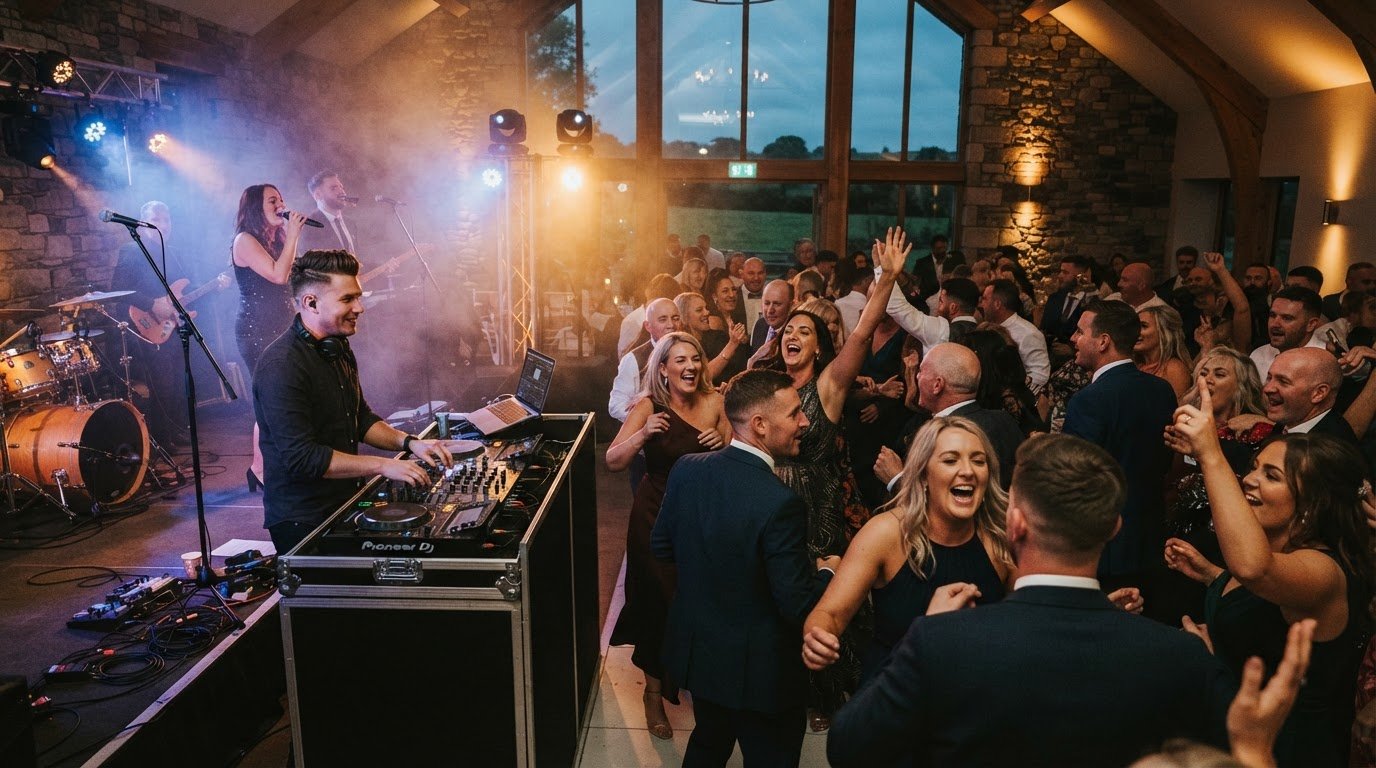
24 Sep The Role of a DJ After the Wedding Band: Keeping the Energy Electric
The most dangerous moment of your wedding reception isn’t an awkward speech; it’s the exact second the live band strikes their final chord. When the guitars cut out and the stage lights dim, your party faces an immediate cliff-edge drop in energy. Understanding the role of a dj after the wedding band is the difference between an empty room at midnight and an unstoppable, hands-in-the-air celebration that surges right through to curfew.
You’ve poured heart and soul into planning an unforgettable night, and worrying about abrupt silences, messy equipment changeovers, or divided music tastes is completely natural. In this guide, you’ll discover how a professional late-night DJ protects dancefloor momentum and why frictionless entertainment keeps every generation moving until the final track. We’ll explore the technical secrets of zero-downtime transitions, crowd preservation, and how to turn midnight into the ultimate party peak.
Key Takeaways
- Understand how the role of a dj after the wedding band transforms live stage momentum into late-night party endurance.
- Learn how reading crowd psychology past midnight keeps every generation dancing as energy levels and musical tastes shift.
- Discover why an integrated Band & DJ Package eliminates awkward changeover downtime, sound checks, and stage clutter.
- See why static automated playlists fail to read a room, handle sudden mood drops, or deliver high-impact transitions.
- Master the ideal late-night reception timeline to coordinate evening food, the final live chord, and an unforgettable closing anthem.
Understanding the Core Role of a DJ After the Wedding Band
A great live band delivers raw sonic power. Two hours of driving drums, blistering guitar solos, and roaring vocals naturally push your guests to a collective high. Then arrives the danger zone. Evening food platters emerge, instruments get unplugged, and tired feet threaten to drain the room. At this exact crossroad, the role of a dj after the wedding band transforms into active crowd preservation. Far from providing mere background music, the DJ acts as the vital custodian of your celebration’s momentum.
Looking at the modern definition of what a disc jockey brings to live events, technical skill and crowd psychology outweigh simple playback. When handled through an integrated Band & DJ Package, this transition features zero changeover downtime. The DJ catches the room before its heart rate drops, immediately reigniting the floor with a fresh sonic direction.
Bridging the Live Energy to Late-Night Anthems
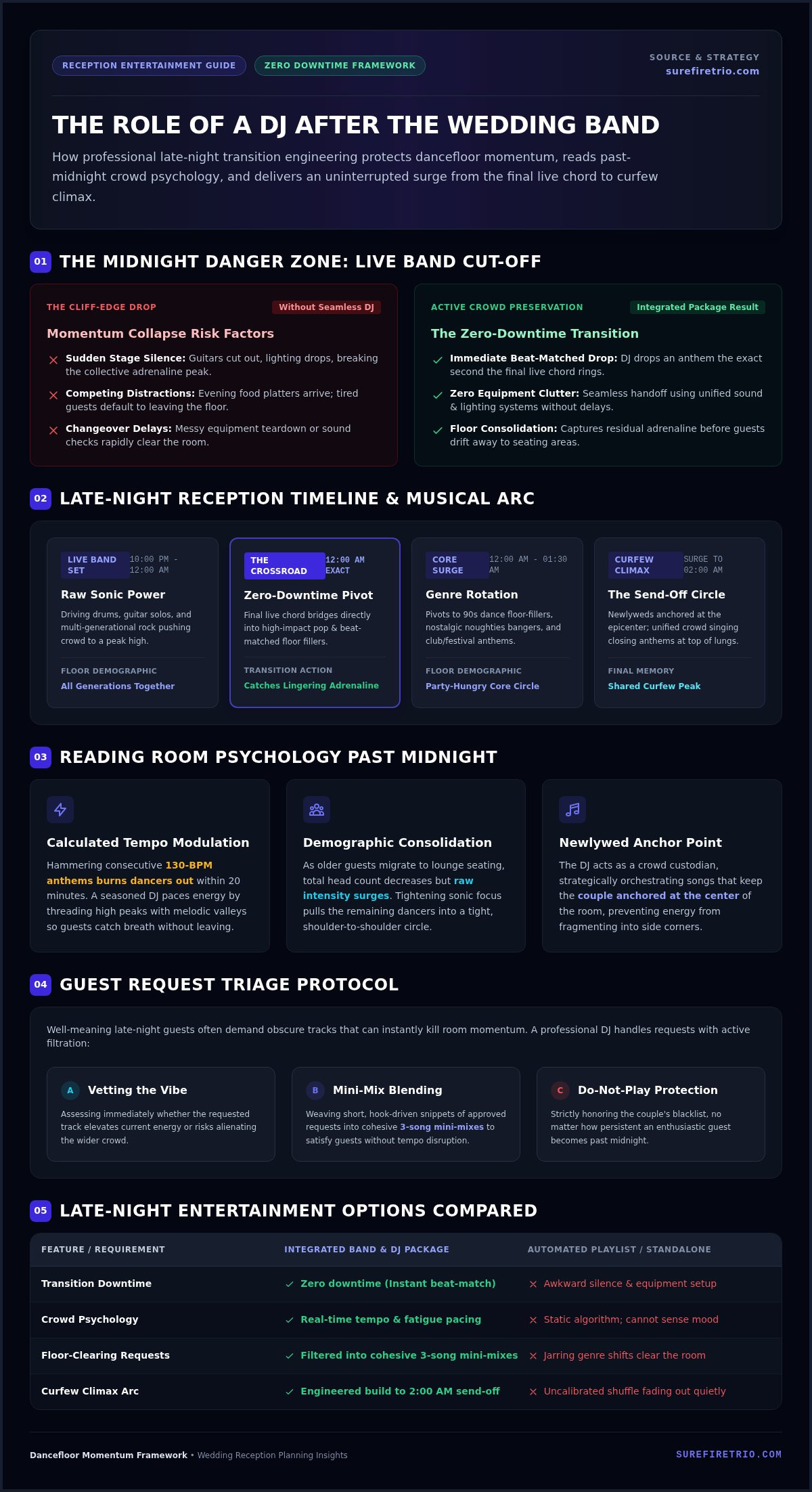
The final ringing chord of a band’s encore should never collide with sudden silence. The second the live set concludes, the DJ drops a punchy, beat-matched anthem that seizes that lingering adrenaline. While older relatives gradually migrate toward lounge seating for late-night chats, the dancefloor naturally consolidates. The DJ pivots away from classic multi-generational rock toward high-impact pop, 90s dance floor-fillers, and modern electronic tracks, keeping the core party demographic moving shoulder-to-shoulder.
Curating the Soundtrack for Curfew Climax
A professional Late-night DJ set doesn’t randomly shuffle popular songs. As professional wedding entertainment specialists like Paramount DJs emphasize, it engineers a deliberate musical arc that surges toward 2:00 AM. As the clock winds down, the DJ strategically rotates genres to stave off physical fatigue, driving the room toward an unforgettable shared climax:
- Momentum Pivots: Shifting effortlessly between pulsing club tracks, nostalgic noughties bangers, and driving indie anthems.
- Crowd Focus: Keeping the newlyweds and their bridal party anchored right at the epicenter of the floor.
- Curfew Finale: Building toward a high-energy send-off circle that leaves everyone singing at the top of their lungs.
Reading the Room: Crowd Psychology Past Midnight
Midnight triggers an invisible psychological shift across every wedding reception. Feet ache from hours of dancing. Evening drinks take full effect. Meanwhile, older generations quietly bid their goodbyes, leaving behind an energetic, party-hungry core crowd. Static playlists fall apart here because an algorithm cannot sense physical exhaustion or fluctuating crowd attention. This crucial inflection point highlights the role of a dj after the wedding band as a real-time room psychologist rather than a human jukebox.
Navigating the Demographic Shift on the Dancefloor
As the clock ticks past midnight, the floor shrinks in physical head count but surges in raw intensity. The musical focus shifts rapidly from broad wedding classics toward club anthems, bass-heavy 90s dance floor-fillers, and festival anthems. Rather than scattering guests across the room, tightening the sonic focus draws dancers into a dense, energetic circle right around the newlyweds.
Handling Guest Requests Without Clearing the Floor
Every late-night wedding party produces well-meaning guests demanding obscure tracks that can instantly kill momentum. An amateur might play a jarring slow ballad or a niche album track simply because a cousin requested it. A seasoned DJ protects the dancefloor by actively filtering requests against the couple’s musical priorities:
- Vetting the Vibe: Assessing whether a request elevates the current energy or risks alienating the wider crowd.
- Mini-Mix Blending: Weaving short, hook-driven snippets of approved requests into cohesive three-song mini-mixes.
- Do-Not-Play Protection: Strictly honoring the couple’s blacklist, no matter how persistent an enthusiastic guest becomes.
Achieving this level of late-night control is effortless when booking a unified Band & DJ Package, where the musicians understand your crowd from the very first dance right up to the final curfew beats.
Comparing Entertainment Options: Package Deal vs. Standalone DJ
Hiring entertainment for your reception usually follows one of two routes: booking a separate third-party DJ or securing an integrated package. While hiring a separate DJ sounds straightforward on paper, the physical reality inside the ballroom often tells a different story. The technical logistics required to run the role of a dj after the wedding band depend heavily on what happens behind the scenes during the changeover.
When two entirely independent acts share a stage, friction points multiply. A standalone DJ brings an independent sound console, duplicate speaker stands, and extra cabling. Staging areas become cluttered, venue staff trip over flight cases, and the party risks halting entirely while equipment gets patched together.
Eliminating Equipment Clutter and Stage Changeover Delays
The biggest threat to late-night energy is the dreaded twenty-minute dead silence. That happens when a separate DJ must wheel in heavy road cases, set up folding tables, and run sound checks only after the live band unplugs their gear. Guests suddenly hear metallic clattering, mic checks, and muffled apologies instead of music. In an instant, people disperse toward the bar, bedrooms, or hotel lobby.
A unified entertainment setup solves this seamlessly:
- Zero Changeover Downtime: The sound system and lighting rig are already tuned, balanced, and active, allowing the music to switch instantaneously.
- Clean Stage Footprint: Eliminates duplicate mixers, redundant PA columns, and dangerous cable tangles on crowded dancefloors.
- Unified Visuals: The stage lighting design remains polished and cohesive rather than resetting to a mismatched lighting rig halfway through the night.
Musical Synergy: Shared Knowledge and Seamless Handoffs
Beyond hardware logistics, musical communication makes or breaks the transition. Nothing damages a night’s momentum faster than a standalone DJ launching their set with the exact rock anthem the band performed thirty minutes earlier. The dancefloor clears, guests roll their eyes, and the vibe stutters.
Choosing an integrated Band & DJ Package guarantees complete musical synergy. Because the musicians handle both parts of the evening, the DJ knows precisely which tracks were played, which genres landed best, and where crowd enthusiasm peaked during the live performance. That shared intelligence ensures the first electronic beat acts as an explosive launchpad rather than an awkward reset, fully maximizing the role of a dj after the wedding band from start to finish.
Why an Automated Spotify Playlist Cannot Replace a Wedding DJ
Plugging a phone into an auxiliary cable feels like a simple cost saver. It looks easy on a spreadsheet. In reality, relying on an algorithm to carry the second half of your wedding reception is a massive gamble. Software cannot read human emotion, evaluate room energy, or react when forty guests suddenly head toward the bar. That responsive adaptability defines the role of a dj after the wedding band, ensuring your celebration stays vibrant rather than running on robotic autopilot.
Streaming applications also introduce severe technical vulnerabilities. Spotty hotel Wi-Fi can trigger sudden audio buffering mid-song, dropping the entire ballroom into agonizing silence. Worse, an unattended screen invites playlist chaos.
The Problem of Dead Air and Fixed Fades
Automated platforms lack musical timing intuition. Even with standard crossfade settings enabled, automated engines frequently drop tracks at clashing tempos or leave awkward gaps. Four seconds of dead air feels like an eternity to dancing guests, silently signaling that it’s time to head to bed. A live DJ executes seamless, beat-matched transitions that pull dancers directly from one hook into the next. They also monitor live acoustics constantly, smoothing out harsh frequencies to prevent late-night ear fatigue.
Preventing Guest Interference and Playlist Chaos
Leaving an unlocked device exposed near the stage creates an immediate party hazard. Well-meaning, drink-in-hand guests will inevitably hijack the queue, skipping a peak-hour anthem mid-chorus to play an obscure track. Furthermore, unmonitored devices cannot manage decibel spikes, regularly tripping strict venue sound limiters and cutting the master power.
Crafting an electric atmosphere demands real-time crowd leadership. While reviewing curated collections like our ultimate wedding party songs provides incredible inspiration, a live expert must pilot those tracks to match room energy. Protect your celebration from flat playlists and awkward silences; secure your full entertainment package to guarantee your dancefloor stays packed until the final second.
Planning the Ultimate Late-Night Finale for Your Reception
Epic wedding celebrations don’t happen by accident. They are engineered through precise timeline coordination. Balancing venue licensing curfews, late-night bar orders, and fluctuating crowd stamina requires seasoned oversight. Executing the role of a dj after the wedding band means steering these moving parts so the celebration builds to an electric crescendo rather than fizzling out in confusion.
During your planning consultations, lock in these vital operational milestones to keep the evening flowing smoothly:
- Band Finale & Food Synchronization: Align the band’s final encore with the arrival of evening platters to keep guests refreshed without cutting floor momentum.
- Curfew Pacing: Clarify venue licensing cut-offs in advance, allowing the DJ to pace decibel levels and tempo before sudden venue house lights switch on.
- Closing Song Strategy: Select your penultimate and final tracks ahead of time so the celebration closes on an absolute emotional high.
Coordinating Midnight Snacks Around the Beat
The arrival of evening food often threatens dancefloor numbers. Dancers frequently peel away the moment hot sliders or cocktail sausages hit the tables. An astute DJ never fights the food. Instead, they shift into infectious, mid-tempo feel-good tracks that keep guests singing along while grabbing a bite. The second plates clear, the DJ ramps the tempo back into overdrive, pulling everyone straight back into the action.
Structuring the Unforgettable Final Circle
Choosing the right closing anthem makes all the difference. It should be a timeless floor-filler that unites every guest across the room without feeling tired or cliché. Integrating this late-night schedule into your comprehensive wedding planning in Ireland guarantees your reception finishes at an absolute peak, giving you and your guests an unforgettable send-off into married life.
Keep Your Celebration Electric Until Curfew
Your wedding night deserves a finale just as thrilling as your grand entrance. Leaving the second half of your evening to chance or a rigid playlist risks emptying the room before the party truly peaks. Transforming live stage momentum into late-night dancefloor endurance is the vital role of a dj after the wedding band. It eliminates awkward room silences, keeps tired feet moving, and gathers every generation together for an unforgettable send-off.
Backed by hundreds of glowing five-star reviews from couples celebrating across Ireland, Surefire Trio takes the guesswork out of evening entertainment. Our integrated sound and lighting setup guarantees zero changeover delay, paired with seamless setlist coordination that ensures no duplicate tracks across the entire night. Don’t let your party lose its spark when the live set wraps up. Keep your dancefloor rocking with our complete Band & DJ Package and celebrate all the way to curfew.
Frequently Asked Questions
How long does a wedding DJ typically play after the live band finishes?
A late-night wedding DJ typically plays for two to two and a half hours, usually running from midnight until 2:00 AM or 2:30 AM. This timing aligns with standard Irish venue licensing curfews and bar closures. The set provides the exact window needed to transition from the band’s final rock encore into late-night dance, pop, and electronic tracks without overwhelming tired guests.
Will there be a gap in music between the wedding band and the DJ?
With an integrated Band & DJ Package, there is zero gap in music. The second the band strikes their final chord, the first DJ track kicks in immediately. Executing this instantaneous handoff is a core part of the role of a dj after the wedding band. If you hire a separate third-party DJ, expect an awkward 15 to 25-minute equipment changeover delay.
Can we provide our own playlist or must-play list for the after-band DJ?
Yes, sharing your must-play tracks and general musical taste is encouraged. Most couples provide a short list of 10 to 15 essential songs alongside their preferred genres. A professional DJ uses these selections as creative guideposts while reading the room in real time, making sure the floor stays packed rather than playing through a rigid, unbending playlist.
What happens if a guest requests a song from our do-not-play list?
Your do-not-play list is strictly honored, no exceptions. If an enthusiastic guest demands a blacklisted track, an experienced DJ deflects the request politely with professional charm. They will steer the guest toward another favorite genre or explain that the set is tightly scheduled. Your musical vision and peace of mind always take top priority over spontaneous guest requests.
Is an integrated Band & DJ Package better than hiring separate suppliers?
Booking an integrated Band & DJ Package offers huge logistical and musical advantages. You deal with a single contract, a shared staging footprint, and zero changeover delay between sets. Because the musicians manage the entire evening, the DJ knows exactly what was already played live, eliminating song repetition and guaranteeing smooth, uninterrupted party momentum until the lights come up.
What equipment does the DJ use after the live band finishes playing?
In a unified setup, the DJ uses dedicated digital mixing controllers patched directly into the band’s professional PA system and lighting rig. This technical integration delivers concert-grade sound and synchronized lighting without cluttering the dancefloor with duplicate speakers, messy cables, or folding tables. Everything stays clean, polished, and fully optimized for the venue’s acoustics.
How does the DJ handle venue sound limiters and late-night noise curfews?
Professional DJs actively manage equalizers and output gain to stay well within venue sound limiters. By trimming harsh sub-bass frequencies that often trip venue sensors, they keep the energy thumping without cutting the power. Understanding the role of a dj after the wedding band means pacing sound levels as curfew nears, wrapping the party smoothly right at the agreed venue finish time.
Sorry, the comment form is closed at this time.