


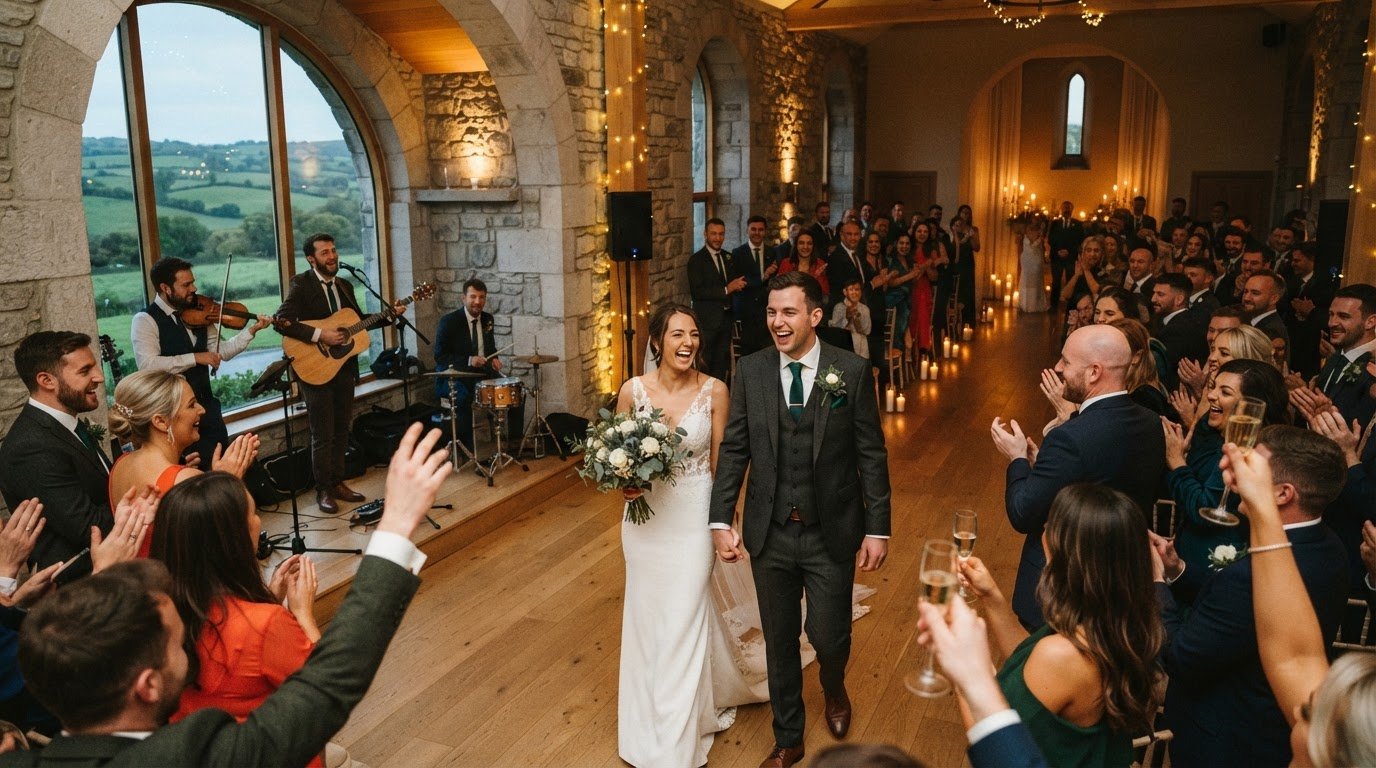
22 Oct Wedding music that tells a story from ceremony to grand entrance
The strongest wedding soundtrack doesn’t begin and end at the ceremony doors. Wedding music that tells a story connects guest arrival, the processional, key ceremony moments, the recessional and the grand entrance, with each song setting up what follows. Choose music that feels like you, then shape its pace and energy to suit each moment.
It’s natural to want songs with personal meaning and a soundtrack your guests can enjoy, too. The right choices can make the ceremony feel intimate, turn your exit into a joyful release and build anticipation for the reception.
This guide explains how to choose ceremony and entrance songs that reflect who you are, work together across the day and create a welcoming atmosphere for your guests. You’ll also find practical ways to balance favourite tracks with different musical tastes, so the story feels cohesive from the first notes to the first big entrance.
Key Takeaways
- Map music to each ceremony moment, from guest arrival through the recessional, so every transition feels intentional.
- Choose songs that carry personal meaning, then consider arrangements that suit the mood and setting.
- Share your must-play and do-not-play songs, while leaving room for the band or DJ to respond to the crowd.
- Pick a grand entrance track that signals the energy you want for the reception, whether that’s joyful, bold or warmly intimate.
- Build the day’s soundtrack with a gradual change in pace, creating a natural journey from reflective moments to a lively dance floor.
1. Ceremony music for guest arrival, the processional, ceremony interludes and the recessional
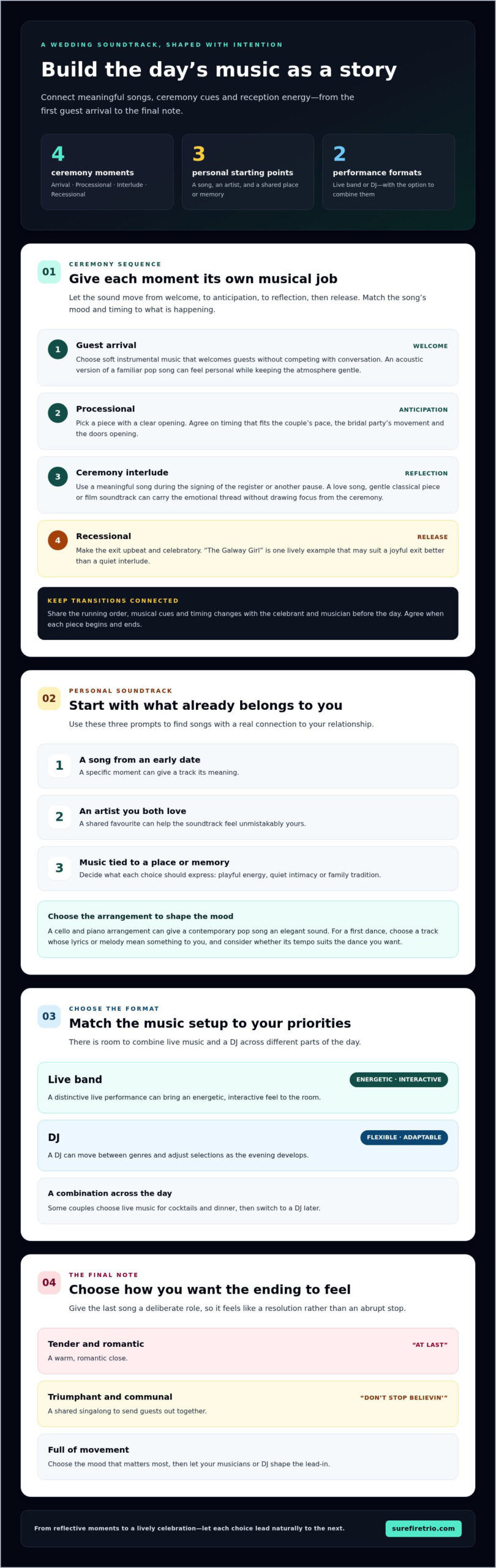
Shape the ceremony soundtrack around four moments: guest arrival, the processional, any interludes and the recessional. Each has a different purpose. Soft instrumental music, such as an acoustic version of a familiar pop song, can welcome guests without competing with conversation. For the processional, choose a piece with a clear opening that can be timed to the couple’s pace, the bridal party’s movement and the doors opening.
What are the best narrative wedding songs for a ceremony? Choose songs whose lyrics or melody connect to your relationship, then match their mood to the moment. A gentle love song can suit the processional, while an instrumental film theme can underscore a reflective pause without drawing attention away from the ceremony.
Irish wedding songs with storytelling lyrics can give a ceremony a personal feel; choose one whose words reflect your relationship and suit the moment. “The Galway Girl,” written by Steve Earle, tells a lively story of an encounter in Ireland. Its upbeat feel may suit a joyful exit better than a quiet ceremony interlude. Consider the lyrics as well as the melody, so the words support the moment.
For ceremony interludes, consider a meaningful song during the signing of the register or another pause. A favourite love song, gentle classical piece or film soundtrack can give guests a reflective moment while keeping the ceremony’s emotional thread alive. Ask a friend or family member to sing or play a chosen piece if their performance adds personal meaning. Agree on the cue with the celebrant and musician, including when the music begins and ends.
A celebrant and live musician can shape the script and music together, connecting your story with the ceremony’s spoken words. For example, a celebrant might introduce a song’s significance before a live acoustic-guitar performance. A ceremony musician can provide live music for guest arrival, the processional, key moments and the recessional. Ukulele can add a brighter colour alongside acoustic guitar.
Make the recessional a moment of release. Choose an upbeat, celebratory song that turns the couple’s exit into the opening beat of the wider celebration. Before the day, share the running order, musical cues and any timing changes with the celebrant and musician. A clear sequence helps each transition feel connected rather than like separate tracks, letting your love story come through in both the script and the sound.
Music for guests’ arrival sets the tone before the couple enters. Live playing can be shaped to the moment and respond to the room in a way a playlist cannot. Personalise the ceremony with a meaningful song, perhaps an acoustic version of a pop hit or a film soundtrack piece. A string quartet, acoustic guitarist or harpist can perform. When celebrant and ceremony music planning come together, words and music can be shaped alongside each other, leading into an upbeat, joyful exit.
2. Choosing music that reflects a couple’s identity
Start with the sounds that already belong to your relationship. Write down three examples: a song from an early date, an artist you both love, and music tied to a shared place or memory. Decide what each choice should express, such as playful energy, quiet intimacy or family tradition. This gives you a clear way to reflect who you are without asking every track to carry your whole love story. For couples who also enjoy discovering new audio stories and entertainment together, Ella Podcasts offers engaging episodes to watch or stream.
Next, consider how the performance style will shape the room. A live band brings an energetic, interactive feel, while a DJ can move between genres and adjust selections as the evening develops. Some couples choose live music for cocktails and dinner, then switch to a DJ later. Match the format to your priorities: a distinctive live performance, flexible genre changes or a combination across different parts of the day.
A first-dance song should feel personal and comfortable to share. Choose a track whose lyrics or melody mean something to you, then consider whether its tempo suits the dance you want. A cello and piano arrangement can give a contemporary pop song an elegant sound. If you prefer a simpler moment, keep the steps natural and let the song’s meaning take centre stage. A customised first-dance song can help make that choice feel deeply personal.
Personal wedding favours can carry the soundtrack beyond the reception. Add a card with the name of a meaningful song and a short note explaining its connection to your story. You could also share a digital playlist as a keepsake or use it as the soundtrack for a wedding highlight reel. Choose tracks you’re happy for guests to revisit, and make the selection reflect the day rather than a broad list of popular songs.
Give the final song a deliberate role, too. “At Last” can bring a warm, romantic close, while “Don’t Stop Believin’” can send guests out on a communal singalong. Decide whether you want the ending to feel tender, triumphant or full of movement. Tell your musicians or DJ which mood matters most, then let them shape the lead-in so the last track feels like a resolution, not an abrupt stop.
For recorded music at a wedding in Ireland, treat playback permissions as a separate planning step from choosing songs. Clarify how music will be played, such as through the venue’s system or a personal device, and establish with the venue who handles any applicable licensing arrangements. Taking care of this practical detail leaves you free to focus on the personal soundtrack, from the first dance to the final note.
3. Balancing couple preferences with guest tastes
Your wedding soundtrack should sound like you, not like a compromise playlist. Start by sharing the artists, genres and songs that feel meaningful to you as a couple. Then identify where you’re happy to broaden the mix. Keep your favourite indie track for a personal moment, for example, while choosing familiar soul or pop for a shared dance-floor set. That balance keeps your identity audible and invites guests in.
Give your musicians or DJ three clear kinds of guidance: must-play songs, do-not-play songs and styles you enjoy. Add context where it helps. “Play this song after dinner because it’s tied to our first trip together” is more useful than a title alone. A note such as “avoid heavy metal, but classic rock is welcome” sets a practical boundary without ruling out an entire mood.
Think about the guests you’ve invited, then choose accessible moments without trying to please everyone with every track. A family gathering with different generations might welcome a familiar chorus, while close friends may respond to a newer dance track. Place personal choices around these shared songs, so the evening moves between the couple’s taste and music guests can recognise.
During the reception, trust the band or DJ to read the room. They can notice whether guests are dancing, singing along or staying near their tables, then adjust the energy and genre. A live band adds an interactive performance; a DJ can shift between musical styles quickly. Your guidance sets the boundaries, while the atmosphere helps shape what comes next.
Build flexibility into the plan for schedule changes. If dinner runs late, a live musician can adapt to the delay; a DJ can adjust the set’s pacing. Tell your entertainment team which moments matter most, such as a family dedication or group singalong, so those meaningful choices remain part of the evening even if timings shift.
Before the wedding, listen through the planned selections together. Mark any songs that feel out of place, and decide where a change in mood should happen. For example, move from relaxed background music into familiar, upbeat tracks when guests are ready to dance. A shared plan gives performers direction without scripting every transition, leaving them room to respond to the crowd.
When discussing the music, make your preferences easy to act on: tell your musicians or DJ what you enjoy, which songs are must-plays and which are do-not-plays. Explain the feeling you hope a song will create or when a particular choice would feel right. This gives performers a clearer sense of your priorities while leaving them room to shape the music around the celebration. If you and your partner disagree about a selection, decide together whether it belongs in a key moment, can be saved for later or should be left out.
As the reception unfolds, trust your band or DJ to read the room and help keep people on the dance floor. Their choices can respond to what guests are doing, while your preferences remain the guide. You don’t need to predict every reaction or specify every transition in advance. A clear sense of what matters to you, paired with confidence in the performers’ judgement, can make the soundtrack feel personal and welcoming without requiring you to manage each song.
4. Grand entrance song choices
A grand entrance shifts the room from conversation to celebration. Choose a track that signals the mood you want guests to feel as you arrive. “You Make My Dreams” by Hall & Oates brings bright, playful energy; “At Last” by Etta James creates a more romantic entrance. Your soundtrack can echo the ceremony’s emotional tone or introduce a bold new chapter.
Start by deciding who will enter and how. You might introduce the wedding party first, then the couple, or make one joint entrance. Match the song’s opening to the first visible moment: a recognisable intro gives guests a clear cue, while a gradual build adds anticipation. Tell your DJ or band who enters when, and agree on the exact musical cue.
Consider how the song feels at the volume and pace of a busy reception room. A strong beat can make a lively walk-in feel effortless, while a slower track suits a relaxed, affectionate entrance. “September” by Earth, Wind & Fire gives the room an immediate groove; “Can’t Help Falling in Love” by Elvis Presley offers a softer contrast. Pick a chorus guests can join if you want a shared singalong.
Your entrance doesn’t need to use the same style as the ceremony music. A couple who chose a gentle acoustic piece for the processional could switch to “Crazy in Love” by Beyoncé for a high-energy reception arrival. That contrast makes the change of scene unmistakable. Alternatively, bring back a melody heard earlier, perhaps in a brighter arrangement, to create continuity across the day.
Before the wedding, decide whether the entrance track should play from its beginning, start at a chosen section or continue into another song. Share the entrance order and cue with the person handling the music. Check the practical details in the room, too: guests need to see the entrance, and the route should let the couple and wedding party move comfortably. Clear cues help the moment land cleanly.
Choose with your guests in mind, but keep the selection personal. A familiar song can bring different generations into the moment, while a favourite track can make the arrival feel unmistakably yours. If the lyrics matter, consider whether they fit the celebration and the people in the room. An entrance song doesn’t need to be a universal favourite; it needs to set the right mood and make the couple’s arrival feel like the start of something.
5. Structuring wedding music as a narrative
Think of the soundtrack as a sequence of scenes, not a queue of unrelated tracks. Give each stage a purpose: welcome, reflection, connection, release, then celebration. For example, begin with gentle acoustic pieces during arrival, shift to a meaningful first dance, then let the reception grow livelier. A recurring melody can tie those scenes together, even when each arrangement has a different tempo.
What wedding songs tell a story about a couple’s relationship? Choose tracks linked to real shared moments, such as the song playing on an early date or music from a favourite journey. “The Book of Love” by Peter Gabriel offers a tender, reflective tone, while “First Day of My Life” by Bright Eyes can suggest a fresh start.
Which wedding songs tell a love story from meeting to marriage? Pair songs that represent different chapters rather than expecting one track to explain everything. “First Day of My Life” can evoke a beginning, while “You’re My Best Friend” by Queen celebrates partnership. Place them at separate moments so the sequence moves from discovery towards commitment.
For a practical structure, write down the day’s key moments in order, then assign each a musical role. Mark where the mood should soften, build or open into dancing. A reflective song during a quiet pause can lead into a brighter entrance track; a shared chorus later can bring guests into the story. This simple map gives every selection a reason to be there.
What wedding songs tell a story without being too sad or dramatic? Try warm, forward-looking choices such as “You’re My Best Friend” by Queen or “Better Together” by Jack Johnson. Their affectionate tone can carry a relationship theme without making the soundtrack feel like a lament. Read the lyrics as well as considering the melody, especially if guests will hear the words clearly.
Use a musical motif to create continuity across different settings. A melody first heard as a quiet acoustic arrangement could return later in a fuller, upbeat version. That change lets guests recognise the connection while marking a new moment. Keep the transitions deliberate: agree on the cue, starting point and mood with whoever is handling the music.
Finish the plan by checking the emotional arc from beginning to end. If the ceremony feels intimate, allow the reception to open with warmth before raising the energy. If the day already starts exuberantly, a calm dinner selection can create contrast before dancing begins. Plan a wedding soundtrack with live music and DJ support to connect those distinct moments into one flowing celebration.
Surefire Trio: Band & DJ Package
Surefire Trio’s Band & DJ Package brings live music and DJ sets together for a wedding soundtrack that can shift with the day. Live songs from the 70s, 80s, and 90s can set a vibrant tone, while the DJ set keeps the celebration moving as the evening unfolds.
Choose a First Dance Song to make your shared moment feel personal, then carry the energy into the Late-night DJ set. This combination suits couples who want live performance alongside the flexibility of DJ music, keeping a thread between meaningful moments and a full dance floor.
Share your musical tastes, must-play songs, and do-not-play choices to help shape the atmosphere around your story. Contact Surefire Trio to discuss the music for your wedding.
Give Your Wedding Soundtrack Its Next Chapter
Before finalising your music, choose the feeling you want guests to carry from the ceremony into the celebration. A few words, such as joyful, intimate or full of energy, can guide your remaining decisions and help every selection feel connected. That’s the heart of wedding music that tells a story: each moment belongs to you while welcoming everyone sharing the day.
If you’d like live performance and DJ music to work together, Surefire Trio offers a Band & DJ Package, a First Dance Song and a Late-night DJ set. Consider which parts of your soundtrack would benefit from that combination, then bring your ideas and favourite songs into the conversation.
Contact Surefire Trio about your wedding music and take the next step towards a celebration that sounds like you. Your story deserves a soundtrack worth remembering.
Frequently Asked Questions
What are the best story-driven songs for a wedding first dance?
“The Luckiest” by Ben Folds, “Beyond” by Leon Bridges and “Grow Old with Me” by John Lennon each offer romantic themes suited to a first dance. Read the full lyrics before choosing, since a memorable chorus can carry a different meaning from the verses. Listen to each track together and picture dancing to it in your wedding clothes. Pick the song that feels true to your relationship, not simply the one with the most obvious love-song title.
How can couples choose wedding music that reflects their own love story?
Wedding music that tells a story can begin with one detail only the two of you recognise, such as a lyric that became an inside joke or a song from a memorable journey. Each partner can suggest a track and explain its meaning in a sentence. Compare the feelings behind those choices, then select music that captures the shared emotion. This turns private memories into a soundtrack guests can enjoy, even if they don’t know the backstory.
Sorry, the comment form is closed at this time.