


19 Oct How to Work With a Venue’s Sound Restrictions
What if a venue’s sound limit could shape the party without taking away its energy? Knowing how to work with a venue’s sound restrictions starts with getting the details early, before you finalise your entertainment plans. A sound limiter or firm music finish time can feel like a big unknown, especially when you want guests to hear the music and enjoy the dance floor.
It’s understandable to worry that restrictions might flatten the atmosphere. Clear expectations give the venue and entertainment team a chance to plan together. This guide covers what to ask, who should coordinate the answers, and how to agree on a practical plan that respects the venue while keeping the celebration lively.
Timing matters, too. Surefire Trio performs 100% live, with a two-hour band set and a short break halfway through, followed by a two-hour DJ set. The DJ set can continue beyond two hours only if the venue permits. The band supplies its sound system, and its equipment and performance are intended solely for wedding venues. With the venue’s requirements understood in advance, you can head into the day with a clear plan.
Key Takeaways
- Get the venue’s sound rules in writing. Clarify the limit, where it’s measured, how monitoring works, and the music cut-off.
- Share the rules with your entertainment team and agree on a practical plan before the wedding.
- Use timing, room layout, and smooth transitions to help preserve the dance-floor atmosphere within the venue’s requirements.
- Prepare a run sheet for the sound check, speeches, live set, break, DJ set, and finish time, with a clear contact for sound-related requests.
- Surefire Trio’s 100% live wedding set lasts two hours, with a short break halfway through, followed by a two-hour DJ set. The band wears white shirts, stylish grey waistcoats, black trousers, and black footwear at every wedding.
What a Wedding Venue’s Sound Restrictions Mean for Your Celebration
A venue sound restriction is a venue-specific condition that sets how amplified sound may be managed during an event, including its level, timing, or monitoring. It doesn’t automatically mean live music is not allowed. The exact terms determine how the evening is scheduled and how the band and venue coordinate.
In Ireland, there isn’t one nationwide statutory decibel figure that automatically applies to every wedding venue. Conditions can differ with the building, its location, and its operating requirements. Before treating “sound limit” as one specific rule, ask the venue what it means in your case. The science of how sound behaves in a space, or acoustics, also helps explain why room layout and sound transmission can affect the experience.
A sound-level limit is different from a music cut-off. A limit sets a maximum level; a cut-off sets the time music must stop. A sound limiter is a device that monitors sound against a set threshold and may interrupt power if that threshold is exceeded. A request to lower the volume, by contrast, is an instruction from venue staff. Each condition calls for a different response, so ask which applies.
Which sound rules might a wedding venue set?
Rules may cover maximum sound levels, whether a limiter is in use, how sound is monitored, and when amplified music must finish. Ask whether the same conditions apply throughout the event or change at particular times, such as later in the evening. Don’t assume that another room or venue follows the same terms.
- A maximum level may apply at a specific monitoring point.
- A limiter may monitor sound and respond when its threshold is exceeded.
- Staff may monitor the room and request a volume adjustment.
- A finish time may apply even if the sound remains within the permitted level.
These are distinct conditions, not interchangeable ways of saying “keep it down”. A written explanation helps your entertainment team understand what the venue expects and plan the set accordingly.
Why do venues set sound limits?
Sound can travel between adjoining spaces, through a building, or beyond its grounds. Venue teams may set conditions to manage neighbouring rooms, the building’s layout or characteristics, guest comfort, and normal operating requirements. The aim is to balance a lively celebration with the needs of the space and the people around it.
That balance is practical, not a reason to assume the party will fall flat. Two rooms can feel different at the same volume because sound interacts with their layout and surfaces. So, how to work with a venue’s sound restrictions starts with understanding the actual condition, not guessing from a label or another venue’s rules. Clear details give you and the band a useful starting point for a plan that respects the venue and keeps the celebration moving.
How to Clarify Sound Restrictions Before Your Wedding
Clear details turn a vague concern into something you can plan around. Choose one person to gather the venue’s requirements, then share the same written information with your entertainment team. That way, nobody is relying on a second-hand summary on the wedding day.
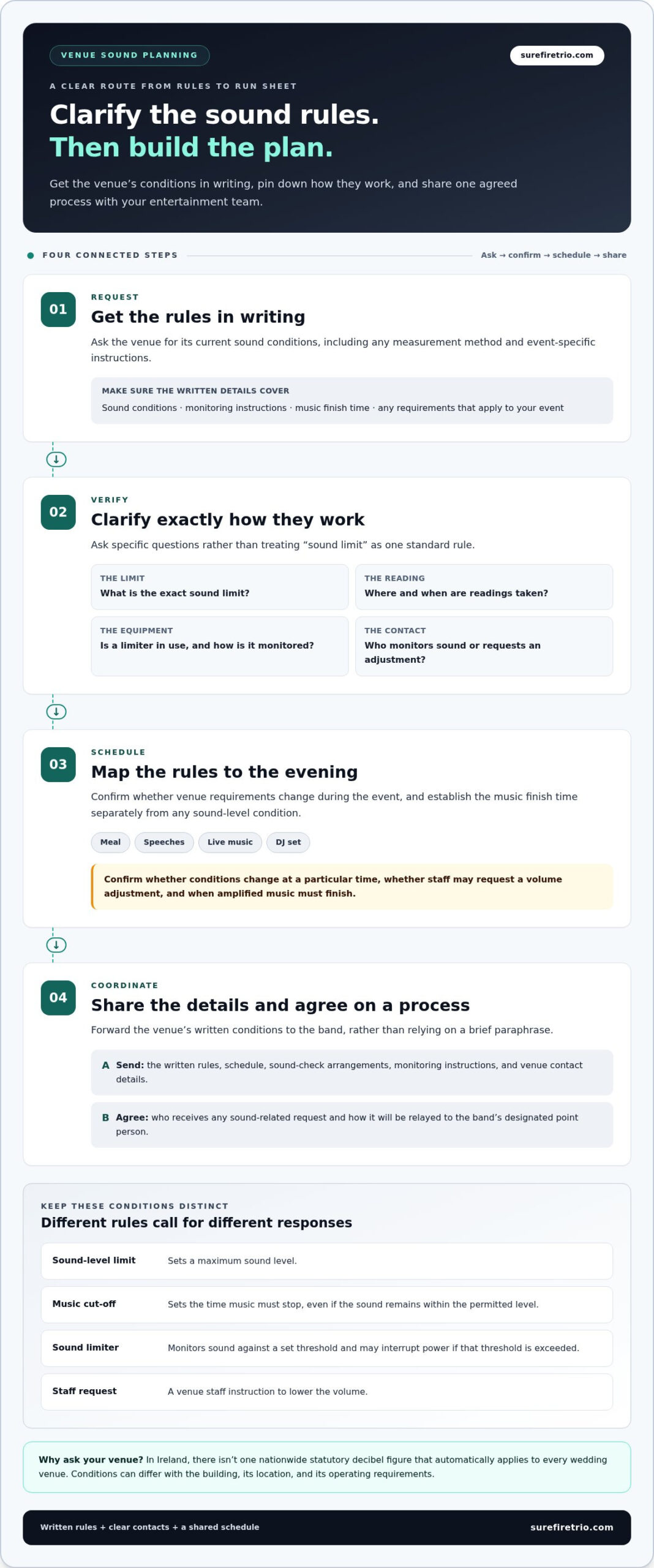
Use this sequence to turn questions into a shared plan:
- Request the rules in writing. Ask for the venue’s current sound conditions, including any measurement method or event-specific instructions.
- Clarify how they work. Confirm the exact sound limit, where and when readings are taken, whether a limiter is used, and who monitors it.
- Map the rules to your schedule. Ask whether requirements change between the meal, speeches, live music, and DJ set. Confirm the music cut-off and whether staff may request a volume adjustment later in the evening.
- Share the details and agree on a process. Send the written rules and venue contact details to your band. Decide who will receive and relay any request on the day.
What should you ask the venue about sound?
Be specific. If the venue gives you a limit, ask how it’s measured and where the measurement point is. If there’s a limiter, ask how it’s monitored and what happens if its threshold is reached. Confirm whether the same rules apply throughout the celebration or whether the venue expects a change at a particular time.
Establish the music finish time separately from any sound-level condition. Ask who can request an adjustment during the event and who the band should speak with directly. Write down the contact’s name and role, along with the agreed process. A clear point of contact helps prevent conflicting instructions.
How should you share the rules with your band?
Forward the venue’s written conditions rather than relying on a brief paraphrase. Include the schedule, sound-check arrangements, any limiter or monitoring instructions, and the venue contact’s details. If the venue has different expectations for speeches, the live set, or the DJ, spell out those transitions so the entertainment team can account for them in the run sheet.
Agree in advance how a change will be communicated. For example, the venue contact can speak to the band’s designated point person, who can confirm the request and pass it on clearly. This means the couple won’t have to manage technical instructions in the middle of the celebration. For broader schedule coordination, the wedding planning guide for Ireland can help connect entertainment timing with the rest of the day.
This is the practical heart of how to work with a venue’s sound restrictions: document the conditions, share them early, and agree on one communication route. When planning a wedding band and DJ set, explore Surefire Trio’s wedding entertainment as part of that conversation.
How to Keep Live Music Enjoyable Within Venue Sound Limits
A lively dance floor isn’t created by turning everything up. A good plan works with the room, the schedule, and the venue’s instructions, then lets the performers build energy through their playing and well-timed transitions. One sound reading can’t tell you exactly how every guest will experience the music.
Sound level is a measured reading; perceived loudness is how sound feels in a particular space; guest enjoyment is the atmosphere created by the music, the timing, and the celebration. They’re connected, but they aren’t interchangeable. Room layout, the position of the dance floor, and the way guests gather can all influence the experience. Discuss room or sound-check decisions with both the venue and the performance team instead of improvising on the day.
Can room layout and timing help?
Possibly, but every room behaves differently. Ask the venue whether the stage and dance floor can be positioned to suit the space and its sound conditions. The band can factor the agreed layout into its setup. Don’t assume that moving speakers or rearranging tables will solve a sound issue, and don’t make changes that conflict with venue instructions.
Timing can help the celebration flow, too. If the venue has different expectations at different points, plan around them. For example, keep speeches clear of the dance set and coordinate any dinner music with the room’s requirements. Confirm changes with venue staff and the performers first. No layout or schedule guarantees a particular acoustic result, but a shared plan can prevent avoidable surprises.
What is the difference between a limiter and a volume agreement?
A limiter is venue equipment that may constrain the sound system’s output. A volume agreement is the understanding between people about the expected sound level and how to respond if the venue requests an adjustment. One is a technical control; the other is a communication plan. Don’t assume how a limiter is set or responds. Use the details supplied by the venue.
To make the plan practical, agree on a few points before the event:
- Where the venue wants the sound check to happen, and who should be present.
- Who will speak to the band if staff request a change during the performance.
- How that request will be relayed clearly, without several people giving conflicting instructions.
- Which transitions need coordination, such as moving from speeches to dancing or from the live set to the DJ.
Keep communication calm and direct. If staff ask for an adjustment, a named contact can pass on the request so the performers can respond in line with the agreed conditions. That’s how to work with a venue’s sound restrictions while protecting the momentum of the night: coordinate early, respect the room, and think about the whole guest experience, not just a number. Surefire Trio’s wedding entertainment can be part of that plan.
How to Prepare a Wedding-Day Sound Plan
A short run sheet gives the venue and entertainment team the same cue sheet. It doesn’t need to cover every detail of the wedding. It should make sound-related timings clear, identify who’s responsible for communication, and show how the music fits around the venue’s requirements.
Build it using the venue’s confirmed conditions, then share the finished version with everyone who needs it. Include the agreed sound-check window, speeches, music start times, breaks, the DJ set, and the venue’s music cut-off. If the venue has a limiter or monitoring process, record the instructions the venue supplied rather than guessing at technical details.
What belongs in the event-day run sheet?
Include the venue contact’s name and role, plus the band’s designated contact for any sound request. Note how an instruction should be passed on during the performance. This keeps communication direct and leaves you free to enjoy the day instead of acting as messenger between the venue and performers.
Make the entertainment timings specific. Surefire Trio’s wedding package includes a two-hour, 100% live band set with a short break halfway through, followed by a two-hour DJ set. Put those blocks alongside the speeches and venue cut-off, then agree the schedule with the venue and band. The DJ set can continue beyond two hours only if the venue permits, so don’t build an unapproved extension into the plan.
- Sound-check window and any venue instructions for the check.
- Speech timings and the planned start of live music.
- The band set and its halfway break.
- DJ start and finish times, aligned with the venue’s cut-off.
- Names and roles for the venue contact and the person communicating with the band.
Reception flow matters. Speeches, meal timings, and music all affect how the evening moves from one moment to the next. Use the wedding reception music guide to consider how music can support those transitions, then put the agreed timings in the run sheet.
What should happen if the venue asks for a sound adjustment?
Agree on a calm, simple response before the guests arrive. The designated venue contact should communicate the request clearly to the band’s chosen point person. The performance team can then respond promptly and coordinate any adjustment within the venue’s stated conditions. Follow the venue’s direction. The middle of a celebration isn’t the time for a debate or for several people to issue instructions at once.
Make sure the person handling practical conversations knows the agreed process. That might be a couple’s representative or another named event contact. The couple can focus on their guests while the designated contacts handle communication. Clear roles, a realistic schedule, and one route for instructions help keep the evening moving.
That’s a practical way to work with a venue’s sound restrictions without leaving the atmosphere to chance. If you’re planning a live band and DJ set, plan your wedding entertainment with Surefire Trio and bring the venue’s sound timings into the conversation early.
How Surefire Trio Works With Wedding Venue Sound Restrictions
Sound planning works best when the venue’s conditions are part of the entertainment conversation from the outset. Surefire Trio performs at wedding venues across all 32 counties of Ireland. Sharing details about the room, schedule, and sound requirements helps everyone prepare with the same expectations.
The wedding package includes a lively, varied, 100% live band set lasting two hours, with a short break halfway through, followed by a two-hour DJ set. Put those timings in the run sheet alongside speeches and the venue’s music cut-off. The DJ set may continue beyond two hours only if the venue permits. Any extension requires venue approval and is the responsibility of the hirer or venue.
What does the band bring to the wedding venue?
Surefire Trio supplies its sound system, stage, dance-floor lighting, and back-up instruments at no extra charge. Sharing the venue’s sound instructions and event schedule in advance helps the band coordinate its setup and timings with the venue’s requirements. Each space has its own conditions, so base the plan on that venue’s guidance.
The band’s standard attire at every wedding is white shirts, stylish grey waistcoats, black trousers, and black footwear. Surefire Trio also has an iSafe Consulting certified Covid-19 compliance officer, and the certificate can be sent to venues. The band’s equipment and performance are intended solely for wedding venues.
What should couples do next?
As you discuss your entertainment plans, share the venue’s written sound conditions, the event schedule, sound-check arrangements, and the venue contact’s details. This gives the band useful context for coordinating the two-hour live set, including its short halfway break, and the two-hour DJ set within the agreed timings. If venue staff request an adjustment during the event, a clear contact route helps keep communication direct while you focus on your guests.
For added continuity, two trained backup DJs, Adam and Alan, are on site. They’re part of the team’s event preparation, alongside the planned handover from the live performance to the DJ set. Align the timings and venue requirements before the celebration rather than assuming every wedding venue has the same rules.
That’s the practical approach to how to work with a venue’s sound restrictions: share the details early, agree on the schedule, and keep communication with the venue clear. Plan your wedding entertainment with Surefire Trio and include your venue’s sound conditions in the conversation.
Make Space for the Celebration
Once the sound plan is agreed, let it do its job in the background. Give the venue and entertainment team the details they need, choose one person to handle practical requests, and give yourself permission to be present. Good preparation is often something guests never notice. It lets you enjoy the first song, the shared cheers, and the moment the dance floor comes alive.
That’s the payoff of knowing how to work with a venue’s sound restrictions: expectations are clear, communication has a path, and the celebration can unfold without you managing every cue. Bring the venue’s requirements into your entertainment conversation early and shape a plan that fits the space and the people in it.
Ready to make the music part of a well-planned day? Plan your wedding entertainment with Surefire Trio and take the next step towards a celebration that feels unmistakably yours.
Frequently Asked Questions
What should I ask a wedding venue about sound restrictions?
Ask for the venue’s written sound policy and how it applies to your room and schedule. Confirm whether there’s a limiter, what condition it enforces, where readings are taken, who monitors it, and the music finish time. Also ask whether rules change between speeches and dancing, and who can give the band instructions on the day. These details are the starting point for how to work with a venue’s sound restrictions.
Can a wedding band play if the venue has a sound limiter?
A wedding band may be able to play with a limiter, but the answer depends on the venue’s conditions and the band’s setup. Ask the venue to explain what the device monitors and what happens if its threshold is reached, then share that information with the performers before the event. A limiter is a condition to plan around, not proof by itself that live music can’t happen.
How can we keep the dancefloor lively with a low volume limit?
A lower volume limit doesn’t have to make the dancefloor feel passive. Ask the band to build momentum through recognisable songs, confident vocals, and contrast between high-energy numbers and brief breathing spaces. Make the dancefloor easy to access and invite guests to join in early, rather than waiting for the room to fill. These choices can help create connection while the venue’s sound conditions continue to guide the performance.
When should we tell our wedding band about the venue’s sound rules?
Tell your band as soon as the venue gives you its sound rules, ideally before the final schedule and sound-check arrangements are agreed. Send the written conditions rather than a summary, and pass on any updates if the venue changes a requirement. Early notice gives the performers time to understand the instructions and coordinate timings with venue staff, rather than interpret new information as guests arrive.
What happens if the venue asks the band to turn the music down?
Direct venue staff to the agreed contact and have that person relay the request to the band’s designated contact. The performers can respond promptly within the venue’s requirements. Keep the exchange brief and calm. Avoid asking guests or several members of the wedding party to pass on separate messages. Once the request has been handled, return your attention to the celebration.
Are venue sound restrictions the same at every wedding venue in Ireland?
No. Sound conditions are set by individual venues and may vary between rooms within the same property, depending on layout, neighbouring spaces, and operating arrangements. Don’t rely on another couple’s experience or a policy from a different venue. Ask for the rules that apply to your event space and date, and get any sound-level, monitoring, or finish-time details directly from the venue.
Can Surefire Trio extend its DJ set if the venue has a later cut-off?
Surefire Trio’s DJ set lasts two hours. It may continue beyond that only if the venue permits, so a later cut-off doesn’t automatically mean the set will be extended. Any extension requires venue approval and is the responsibility of the hirer or venue. Build the schedule around the confirmed finish time, and agree on any approved extension before the event.
Sorry, the comment form is closed at this time.