



16 Oct How to Deal With Wedding Guest Song Requests Without Losing the Dance Floor
What if the best way to protect your dance floor is to welcome song requests without promising to play every one? If you’re wondering how to deal with wedding guest song requests, treat them as suggestions, not instructions. A familiar track might spark a singalong, while another could pull the music away from the mood you want.
It’s fair to want guests to feel included while keeping your wedding music personal. You don’t have to choose between saying yes to everything and sounding unkind when you say no. A clear, flexible request policy gives you room to make thoughtful decisions and lets everyone know who has the final say.
In this guide, you’ll learn how to set expectations before the wedding, respond warmly to requests on the night, and judge which songs fit the moment. We’ll also look at how a live band and DJ can bring an eclectic song list and audience interaction to your celebration without handing over the playlist. The aim is music that feels unmistakably yours and keeps the party moving.
Key Takeaways
- Learn how to deal with wedding guest song requests by treating them as suggestions to consider, not automatic additions to the playlist.
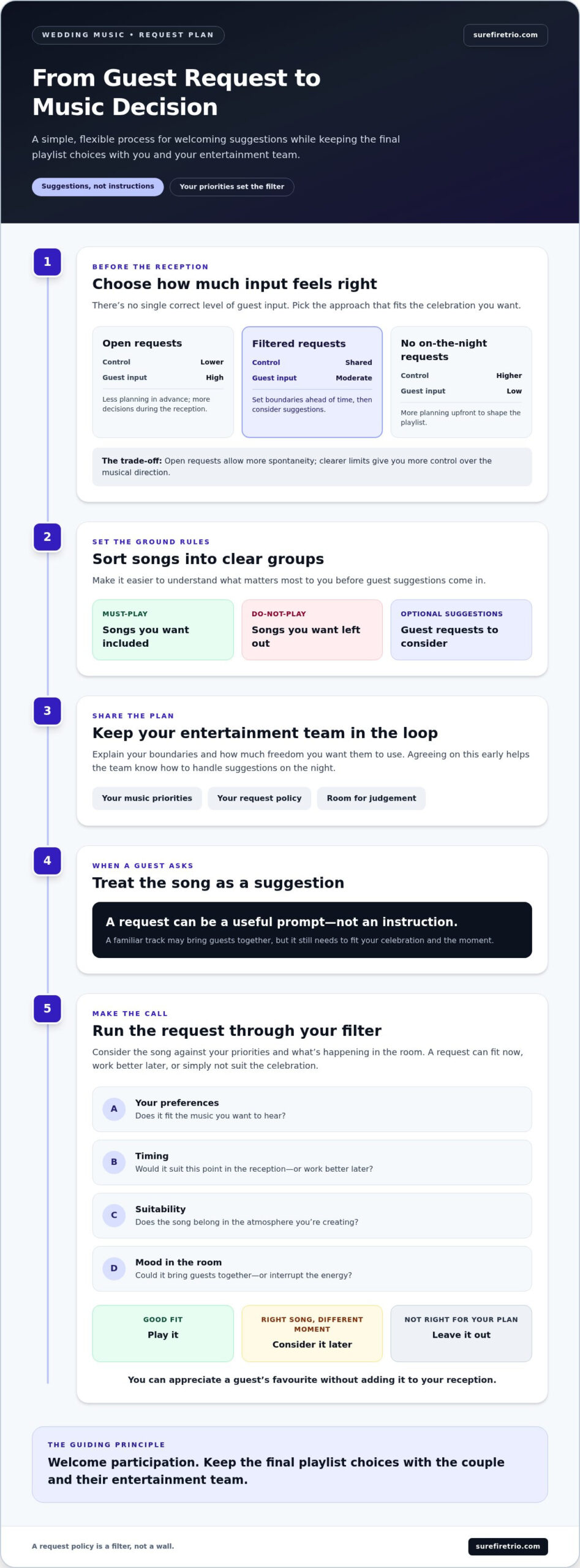
- Compare open requests, requests within clear boundaries, and no on-the-night requests to find a policy that suits your reception.
- Use a simple filter to weigh each song against your preferences, the timing, its suitability, and the mood in the room.
- Set expectations by separating must-play songs, do-not-play songs, and optional guest suggestions, then share the plan with your entertainment team.
- See how Surefire Trio’s 100% live band and professional DJ service, serving all 32 counties of Ireland, can support a personal, guest-friendly music plan.
How to Deal With Wedding Guest Song Requests Without Losing Your Music Vision
You want guests to feel part of the celebration. You also want the music to sound like you, build the atmosphere you’ve imagined, and keep the dance floor inviting. Those aims can sit side by side. A request policy is an agreement about which guest suggestions may shape the music and how they’ll be considered.
A flexible wedding request policy welcomes suggestions while leaving the final playlist choices with the couple and their entertainment team.
That’s the heart of how to deal with wedding guest song requests: make space for participation without letting one song, or one guest, take over the night. A request can be a useful prompt, not an instruction. Whether it suits your celebration depends on your priorities, the moment, and how it may land with the room.
Why wedding guests make song requests
A familiar song can give guests an easy way to join in, sing along, or step onto the floor. A request might carry a personal memory, reflect a cultural association, or simply be a tune someone loves to dance to. Those reasons can make a suggestion meaningful, even if the song isn’t part of your musical vision. Exploring Wedding music traditions can also help you consider the different styles and associations music may bring to a celebration.
What couples want to protect
Your priorities might include a lively atmosphere, songs that feel personal, or a dance floor where guests of different ages feel comfortable. Protecting those priorities doesn’t mean dismissing anyone’s taste. It means distinguishing between inviting suggestions and handing over control of the playlist. You can appreciate why a guest loves a track without deciding it belongs in your reception.
Think of the request policy as a filter, not a wall. You might welcome songs that fit your taste and the mood of the evening, while leaving out tracks that clash with the atmosphere you’re creating. A slower song may suit one point in the reception but interrupt a high-energy stretch later. A familiar chorus could bring guests together, while a personal favourite may work better as a suggestion than a must-play.
There’s no single correct level of guest input. Some couples enjoy a wide mix of suggestions; others prefer to choose nearly every song themselves. Both approaches can be considerate. The useful question is not whether guests should have a say, but how much influence feels right for you. Agreeing on that early helps you welcome the people you love while keeping the celebration unmistakably yours.
Which Wedding Guest Song Request Policy Fits Your Reception?
The right policy depends on the kind of celebration you want, not on a universal rule about what couples should allow. You might enjoy spontaneous guest suggestions, prefer a curated mix, or want the music plan settled in advance. Each approach can work. Choose deliberately so your entertainment team knows how much freedom to use and guests aren’t left guessing.
Open requests, filtered requests, or no requests
Open requests invite the most guest input and can bring unexpected favourites into the mix. The trade-off is less control over the musical direction. Filtered requests leave the door open while making your preferences clear. A no-request policy gives you the tightest control and can suit a carefully planned playlist, though it leaves less room for spontaneous suggestions.
| Policy | Control level | Guest involvement | Likely planning effort |
|---|---|---|---|
| Open requests | Lower | High | Lower in advance, with more decisions during the reception |
| Filtered requests | Shared | Moderate | Moderate, as you set boundaries ahead of time |
| No on-the-night requests | Higher | Low | More planning upfront to shape the playlist |
These are broad guides, not guarantees about how the night will feel. An open policy doesn’t mean every suggestion will suit the moment, and a no-request policy doesn’t mean guests can’t enjoy the music. The difference is how much influence you’re comfortable giving them.
Choose boundaries that reflect your priorities
Start by ranking three things: guest participation, your personal favourites, and musical consistency. If you value spontaneity most, consider open requests, while leaving real-time choices to the person managing the music. If your own taste and a consistent atmosphere come first, filtered or no requests may feel more comfortable.
Then picture the reception you want. A lively, free-flowing evening may leave room for more improvisation; a carefully paced celebration may call for clearer limits. Neither choice is rude or restrictive. It’s a way to make sure the music reflects your preferences and the mood you’re hoping to create. If you’re unsure where to begin, agree on a few boundaries first, then leave room for judgement on the night. That middle ground is a practical starting point for how to deal with wedding guest song requests.
If you’re shaping a plan around live music and DJ entertainment, Surefire Trio’s wedding band and DJ package offers a useful starting point for thinking through how guest suggestions fit your reception.
Should You Play Every Wedding Guest Song Request? A Practical Filter
No. Guest suggestions deserve consideration, not automatic acceptance. A request can be a brilliant fit, a better choice for later, or simply not right for your celebration. The aim isn’t to judge someone’s taste. It’s to protect the atmosphere you’ve planned while staying open to songs that could bring guests together.
Use this four-question filter before adding a song to the mix. It gives you and your entertainment team a quick, consistent way to make a call, even as the energy in the room shifts.
A four-question test for requests
- Does it fit your agreed preferences? Consider your musical priorities and any do-not-play boundaries. If it crosses a clear boundary, you have your answer.
- Is the timing right? A romantic ballad might feel lovely during a quieter moment, but interrupt a lively run of dance-floor favourites.
- Does it suit the room? Think about the mood guests are responding to now. A familiar singalong may lift the energy; a slower or less fitting track could change its direction.
- Can you consider it without promising it? Keep the suggestion in mind while the person managing the music decides whether it fits the flow of the reception.
Timing matters because a song isn’t a fit or a mismatch in isolation. Imagine guests are singing along and the dance floor is filling. A request that slows the pace might work later, but playing it immediately could break the momentum. Good judgement means reading the moment, not just checking a title against a list.
How to decline a request warmly
A brief thank-you acknowledges the guest’s thoughtfulness without committing you to the song. Keep the response friendly and simple: “Thanks for suggesting that, we’ll keep it in mind.” Avoid criticising the track or explaining why the guest’s taste is wrong. If another song genuinely fits your agreed plan, you can offer it as an alternative; there’s no need to invent one just to soften the answer.
Declining a song is a decision about the music’s fit, not a rejection of the guest who suggested it.
If you’re making decisions yourself on the night, ask your entertainment team to apply the same filter rather than putting you on the spot with every suggestion. Agreeing beforehand which requests they can consider, and which boundaries are firm, helps them respond consistently. That leaves you free to enjoy the celebration instead of managing a queue of song choices.
This is a practical way to approach how to deal with wedding guest song requests: listen graciously, check the song against your preferences and the room, then make a clear call. Some requests will earn a place in the set. Others can be thanked and declined without dampening the party or the connection behind the suggestion.
How to Set Wedding Song Request Expectations Before the Reception
A little planning now can spare you awkward decisions on the night. Agree what matters most, make your boundaries clear, and give your entertainment team a short brief they can use while the celebration is moving. Guests can still feel invited in without assuming every suggestion is guaranteed to make the playlist.
- Agree your priorities. Talk together about the atmosphere you want, the music that feels personal to you, and how much guest input you’re comfortable with. If you disagree, settle on a shared approach before inviting suggestions.
- List your songs and boundaries. Separate your music notes into must-play songs, do-not-play songs, and optional guest suggestions. Keep the must-play list focused on the songs that matter most, and make exclusions clear rather than leaving room for guesswork.
- Communicate the policy. If you’re gathering ideas in advance, explain that suggestions help shape the music but don’t dictate it. You might write: “We’d love to hear a song you enjoy dancing to. We’ll share your suggestions with our entertainment team, who’ll choose what fits the music and atmosphere on the night.”
- Brief your entertainment team. Share the same preferences and boundaries, plus any key moments that need protected music choices. Tell them who has the final say and whether they can use their judgement to consider requests during the reception.
Build a short, usable music brief
Keep the brief easy to scan: a few must-plays, clear do-not-play songs, and optional suggestions in separate sections. Add a sentence about the atmosphere you’re aiming for, such as upbeat and singalong-friendly, and flag key moments where you want a particular choice. If you’re gathering ideas for the ultimate wedding party songs guide, use it to spark options, not to create an exhaustive set list.
More detail isn’t always more helpful. A long list of exact songs for every moment can leave little room to respond to the room’s energy. Give your entertainment team the essentials and the boundaries, then leave space for professional judgement within the plan.
Tell guests what kind of input is welcome
Keep the invitation warm and straightforward. For example: “Have a song that gets you on the dance floor? Send it our way. We can’t promise every suggestion will be played, but we’d love to hear your ideas.” If you’re planning with a wedding planning in Ireland guide, add this wording wherever you’re already sharing guest information, rather than making the request policy feel like a formal rule.
Clear expectations are a practical part of how to deal with wedding guest song requests. They help guests understand that suggestions are welcome while the final music choices remain guided by your preferences and the celebration’s flow. For a live band and DJ package shaped around your wedding music, plan your wedding entertainment with Surefire Trio.
How Surefire Trio’s Live Band and DJ Package Fits Your Request Plan
A live band and a DJ bring different sounds and energy to a wedding reception, so plan them as parts of one music vision. Surefire Trio is a three-musician professional wedding band serving all 32 counties of Ireland. The band performs 100% live and provides a professional DJ service, bringing live music and a DJ set together for your reception.
Before the celebration, share your musical priorities: must-play songs, do-not-play choices, and the atmosphere you want guests to feel. That gives the entertainment team a clear picture of your preferences across the reception. Requests can be considered against that plan, but no individual song should be assumed or promised just because a guest suggests it.
What to include when planning music with a live band and DJ
Think about the live performance and DJ set as two parts of the same evening, not separate playlists with unrelated goals. You might want the overall mood to feel upbeat and welcoming while still allowing the sound and song choices to vary. Share which moments need a particular song or feeling, and where you’re comfortable leaving room for the music to respond to the celebration.
Surefire Trio has an eclectic song list for guests across age groups, and audience interaction is part of the performance. That range can help inform your planning, but it doesn’t mean every requested song will be played. Two backup DJs, Adam and Alan, are on site and trained to DJ. Sharing your request boundaries and preferences gives the team useful context without handing over your music vision.
For a straightforward brief, group your notes under three headings: must-play, do-not-play, and optional suggestions. Add a line describing the atmosphere you’re aiming for, then identify any key moments where you have a specific choice in mind. This keeps your guidance practical and leaves room for good judgement on the night.
The practical details couples should know
The band performs a two-hour lively and varied set, with a short break halfway through for tea, coffee, or buffet service. The DJ set is two hours and can continue beyond that only if the venue permits. Any extension is the hirer’s or venue’s responsibility, so include the venue’s cut-off time when planning the evening’s music.
Surefire Trio’s standard dress for every wedding is white shirts, stylish grey waistcoats, black trousers, and black footwear. The band’s equipment and performance are intended solely for wedding venues. These practical details sit alongside the music plan, helping you understand the setting the entertainment is designed for.
A clear request approach makes it easier to welcome guest suggestions while keeping the celebration personal. If you’re ready to explore a live band and DJ for your wedding, Explore Surefire Trio’s wedding entertainment.
Set Your Music Plan in Motion
A thoughtful request policy doesn’t need to script every moment. It gives you a clear starting point, so you can welcome guests’ ideas and still let the music unfold in a way that feels right for your celebration. Decide what matters most, share those priorities with your entertainment team, and let the room’s energy guide the smaller choices.
That’s a confident way to approach how to deal with wedding guest song requests: make the boundaries clear, then enjoy the night instead of managing every track. With a plan in place, you can be present for the singalongs, spontaneous dances, and songs that become part of your wedding story.
Surefire Trio is 5-star reviewed, with testimonials praising the dance-floor atmosphere. To plan your wedding music around your preferences and guest experience, explore Surefire Trio’s wedding entertainment.
Frequently Asked Questions
Should you play every wedding guest song request?
No. Treat requests as possibilities, not obligations. A guest might suggest a song that suits your taste but feels out of place during a quieter part of the evening. You could thank them and let the entertainment team keep it in mind for a more suitable moment. This gives the guest a positive response without requiring you to interrupt music that’s already working.
How do you politely decline a wedding song request?
Thank the guest and respond warmly, even if the song won’t be played. For example: “Thanks for telling us why you love that song. We’ve chosen a different direction for tonight, but we’re glad you suggested it.” Keep it brief; a long explanation can make a simple decision feel personal. If a fitting alternative comes to mind, offer it, but don’t suggest one just to fill the silence.
Can wedding guests request songs from the band or DJ?
Yes, if the couple decides to welcome requests. Set the approach with your entertainment team before the reception, including whether guests can ask directly or should share ideas another way. For example, you might allow requests during the evening while asking the team to use its judgement about timing. That makes the process clear and helps avoid guests interpreting a polite “thanks” as a promise.
When should you give your wedding DJ a must-play and do-not-play list?
Prepare your list while planning the reception and share it with your entertainment team before the wedding. Keep it easy to interpret: mark songs that are essential, songs you want excluded, and the overall mood you’re aiming for. If a song matters for a particular moment, label that too. A short, prioritised brief gives the team clearer direction than a long list with no indication of what matters most.
Should you ask wedding guests for song requests in advance?
You can, especially if inviting guests to contribute feels right for your celebration. Asking in advance gives you time to review ideas without making decisions in the middle of the party. You could invite one suggestion per guest and explain that it may influence the playlist but isn’t guaranteed to feature. This lets people share a meaningful favourite while keeping the final choices with you.
What should you do if a guest requests an inappropriate wedding song?
Decline it calmly and follow the boundaries you set for the celebration. If the request conflicts with your preferences or the moment, there’s no need to debate its lyrics or explain your reasoning in front of other guests. A simple “Thanks for suggesting it, but we’re keeping to our planned music tonight” is clear and courteous. If you’re busy, let your entertainment team handle the response using the guidance you’ve already shared.
How can you keep guest requests from taking over the wedding playlist?
Decide who will handle requests and give that person a clear sense of your priorities. That might be one member of the wedding party or someone from your entertainment team, so you’re not repeatedly pulled into music decisions. This is a practical part of how to deal with wedding guest song requests: create one route for suggestions, then let the agreed plan guide which ideas make it into the celebration.
Sorry, the comment form is closed at this time.