


12 Oct When Should the First Dance Happen? Find the Right Moment
What if the best first-dance moment is guided by the rhythm of your reception, not tradition? If you’re wondering when should the first dance happen, the choice can feel bigger than picking a song. Have it before dinner and you may worry about interrupting the evening; save it until afterwards and you may wonder how to get guests ready to fill the dance floor. Speeches, meal service and evening entertainment all play a part.
There’s no single right answer. The best moment is the one that feels comfortable for you and gives the celebration a natural flow. This guide compares dancing before dinner with saving it until afterwards, and looks at how nerves, speeches and the energy you want can shape your decision. You’ll also find practical ways to coordinate the song and announcement with your entertainment, so the first dance feels personal and the next beat leads smoothly into the party. With live musicians ready to cue you in, the spotlight moment can become the start of an unforgettable night.
Key Takeaways
- There’s no fixed rule for when should the first dance happen; choose a time that fits your reception and feels right for you.
- Compare an earlier dance with a post-dinner moment to decide how you want to focus guests’ attention and shape the evening’s energy.
- Use speeches, meal service and room transitions to find a natural place in the running order.
- Share the timing and cue with your reception coordinator and entertainers so everyone knows what happens next.
- Decide whether your first dance will be a special moment on its own or the opening beat of the party.
When should the first dance happen at a wedding reception?
There’s no mandatory time for a first dance. Choose a moment that fits your reception schedule and feels comfortable for you as a couple. The timing matters because the dance can mark the shift from the day’s formal moments to a more relaxed evening celebration. Plan it thoughtfully and it will feel like part of the story, not an interruption.
The best time for a first dance is the point that suits you and your reception’s natural flow. That might be early, while guests are focused on you, or later, when they’re ready to join the party. Decide what you want the room to feel like, then build the timing around that experience.
Is there a traditional time for the first dance?
The first dance is a familiar part of wedding reception traditions, but familiar doesn’t mean compulsory. Couples often place it around the reception’s formalities or use it to open the evening dancing. Those are options, not rules. Your venue’s schedule, meal service and personal preferences all matter, so choose an arrangement that suits your plans rather than following a format that doesn’t feel like you.
What should guide your decision?
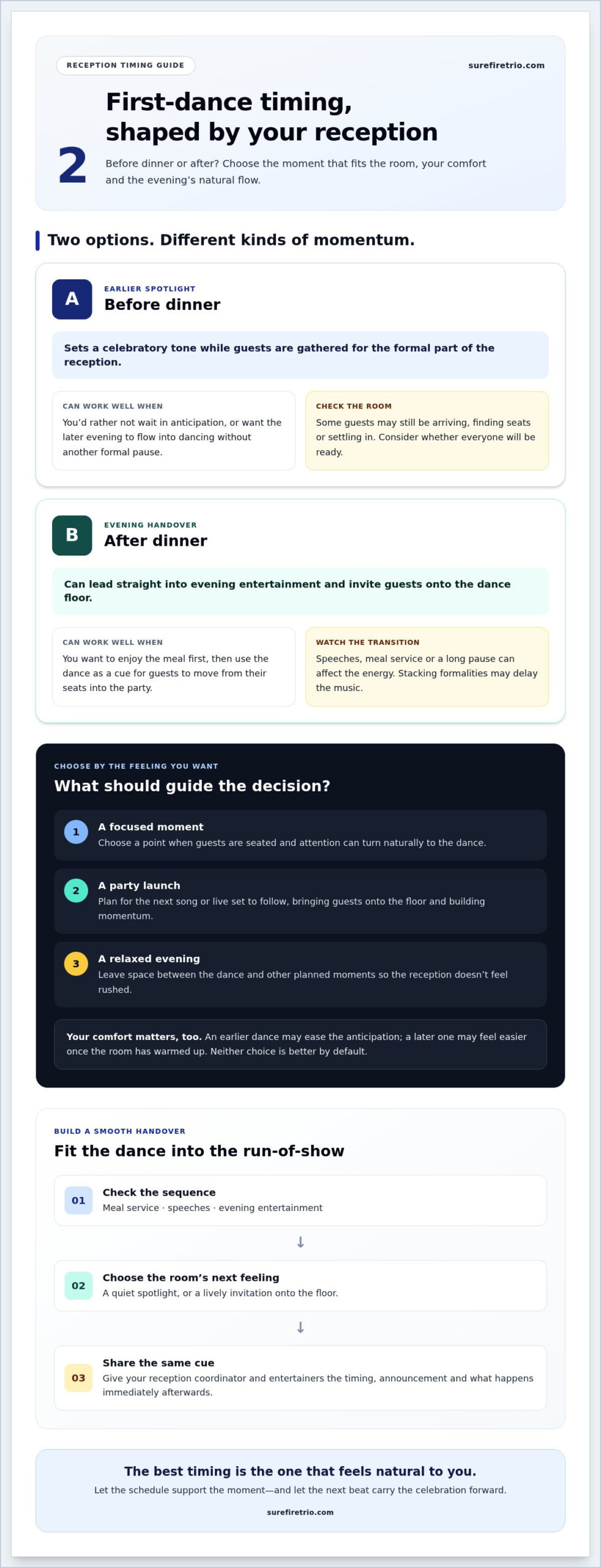
Start with the reception sequence. Check when guests will be eating, when speeches are planned and when your evening entertainment begins. Then decide whether you’d prefer a quiet spotlight moment, with everyone watching, or a lively launch that invites guests straight onto the floor. If you’re mapping several moving parts, a wedding planning guide can help you think through the wider celebration.
- For a focused moment: Choose a point when guests are seated and attention can turn naturally to the dance.
- For a party launch: Place it where the next song can bring guests onto the floor and build momentum.
- For a relaxed evening: Leave space between the dance and other planned moments, so the reception doesn’t feel rushed.
Also consider your own comfort. If being the centre of attention feels daunting, an earlier dance may let you enjoy the rest of the reception without waiting for it. If you’d rather share the spotlight once the room has warmed up, a later moment may feel easier. Neither choice is better; the right one suits your energy and the atmosphere you want.
Wedding planning involves coordinating many moments, and a small timing adjustment can make the evening feel more seamless. Once you’ve chosen a point in the schedule, share it with the person coordinating the reception and your entertainers. Live musicians can cue you into the dance, then carry the energy forward when you’re ready to open the floor. That clear handover helps the first dance land with confidence and gives the celebration its next beat.
First dance before or after dinner: how each option shapes the reception
Before you settle on a time, picture what guests will be doing and how you want the room to feel. A first dance before dinner can bring the formal moments forward and set the celebration in motion early. Waiting until after dinner can make the dance a clear handover into evening entertainment. Neither format wins by default. If you’re asking when should the first dance happen, start with the reception’s rhythm and your own priorities.
| Timing | How it can shape the reception | What to consider |
|---|---|---|
| Before dinner | Sets a celebratory tone while guests are gathered for the formal part of the reception. | Depending on the schedule, some guests may still be arriving, finding seats or settling in. |
| After dinner | Can lead straight into evening entertainment and invite guests onto the dance floor. | Speeches, meal service or a long pause may affect the energy of the transition. |
Dinner timing and guest energy can help you decide whether the dance should feel like an early highlight or the spark that starts the evening party.
What changes when the first dance happens before dinner?
An earlier dance can give the reception an immediate celebratory lift and let you complete a key formal moment before the meal. It may suit couples who would rather not wait in anticipation or who want the later evening to flow into dancing without another formal pause. The trade-off is that guests may still be settling in. Consider whether everyone will be in the room and ready to share the moment before you begin.
What changes when the first dance happens after dinner?
After dinner, guests may be ready to move from their seats into the evening’s entertainment, making the dance a natural opening cue for the floor. It also gives you a chance to enjoy the meal before stepping into the spotlight. Plan the sequence around speeches and other formalities. Stacking several moments together can delay the music and weaken the handover into dancing.
Think beyond the clock. If your priority is a focused moment with guests’ attention, choose a time when the room is settled. If you want the dance to kick-start the party, plan for the next track or live set to follow without an awkward gap. Wedding industry resources, including the wedding industry professional guidelines, can provide broader context as you shape the evening’s format.
Once you’ve picked the timing, give the reception coordinator and entertainers the same running order. They can align the announcement, music cue and what happens immediately afterwards. A customised first-dance song can make the moment feel unmistakably yours, while live music followed by a DJ set can carry the room from that personal spotlight into a full dance floor. Explore Surefire Trio’s first-dance music and entertainment as you imagine how you’d like that transition to sound.
Choose first-dance timing around speeches, guests and your comfort
Your reception has its own rhythm. To decide when should the first dance happen, weigh three things together: the atmosphere you want, the sequence of planned moments and how comfortable you feel being in the spotlight. A neat schedule on paper may not feel right if it puts your dance between a speech and the next course, or leaves you waiting nervously for hours.
Use these questions to find a moment that fits:
- What mood do you want? A quiet, focused moment calls for guests to be settled and ready to watch. A more relaxed, shared moment might suit a cue that invites everyone onto the floor afterwards.
- What else is happening? Let the meal, speeches and any room change finish cleanly instead of competing for guests’ attention.
- What feels comfortable? Choose a point that gives you time to enjoy the reception without building up pressure around the dance.
These priorities can point in different directions. You might want a lively start but prefer not to dance immediately after a speech, for example. Give the reception coordinator and entertainers your preferred order, then agree on a cue that leaves a natural pause between moments. For additional wedding first dance timing advice, use external planning guidance as a reference while keeping your schedule and preferences at the centre.
How do speeches and the meal affect the timing?
Look at the venue’s running order, including meal service and speeches, before settling the dance into place. Avoid scheduling it while staff are serving or guests are expected to listen to a speaker. If a speech runs long, a flexible cue agreed with your entertainer can help the next moment feel intentional, not hurried. Share the sequence with the people coordinating the reception so everyone is working from the same plan.
What if you feel nervous about dancing in front of everyone?
A customised first-dance song can help the moment feel more like yours, and live musicians can give you a clear cue to step onto the floor. Agree in advance on what follows: a favourite track, an invitation for guests to join, or a smooth move into the evening set. If you’re picturing that next wave of dancing, explore wedding party song ideas for inspiration. Surefire Trio’s live band and DJ entertainment connects the spotlight moment with the celebration that follows.
Plan the first-dance moment with a clear reception run-of-show
A clear running order turns the first dance from a question mark into a confident cue. Once you’ve decided when should the first dance happen, make sure the people guiding the reception and the music are working to the same plan. That way, you can focus on the moment instead of wondering what happens next.
Build the plan in a few simple steps:
- Settle the timing. Place the dance in the reception sequence, allowing the preceding moment to finish and leaving space for the transition.
- Share the order. Give the agreed timing to the person coordinating the reception and your entertainers, so the venue team and musicians or DJ know the plan.
- Confirm the cue. Decide how the dance will be announced, which version of the song will play and where you’ll start from.
- Plan what follows. Choose whether guests should watch, join you on the floor or move into the next part of the entertainment.
Even if the schedule shifts slightly, a shared plan gives the team a clear reference point and helps the transition stay composed.
How do you make the transition into the first dance feel smooth?
Agree on a simple signal that tells guests the dance is about to begin. It might be a short announcement followed by the opening notes of your song. Decide where you’ll be just before the cue, such as at your table or near the edge of the dance floor, and give yourselves a moment to move into place without rushing. Then make the next musical moment clear: guests can watch for the full song or be invited to join you when it ends.
If there’s a room change or another reception moment immediately beforehand, include it in the sequence. The coordinator can help the transition feel unhurried, while the entertainer can give you a clear musical cue. Wider drinks reception music ideas can help shape the atmosphere across the day, but the first dance still needs its own agreed song, announcement and cue.
What should you share with your musicians or DJ?
Give your entertainment team the song title and version you’ve chosen, along with any planned edit or preferred ending. Share where the dance sits in the running order, how you’d like it announced and whether guests should be invited onto the floor afterwards. With that information, live musicians can cue you into the dance and support the handover into the party. A customised first-dance song adds a personal touch; the practical details help everyone deliver it smoothly.
Ready to shape a first dance that flows into the celebration? Explore Surefire Trio’s band and DJ entertainment for a connected live-music and DJ experience.
Make your first dance the natural start of the evening celebration
Your first dance can be a beautiful moment on its own or the opening note of a packed dance floor. Decide which role you want it to play, then make the next musical cue clear. If guests know whether to keep watching or join you, the moment feels confident and the celebration can gather energy without a pause.
The song is part of that signal. A gentle, meaningful choice can keep the spotlight intimate; a brighter, more upbeat mood can hint that the party is about to begin. Think about what feels true to you as a couple, not just what will look good from across the room. The right track gives the moment its own character.
How can your first-dance song set the tone?
Choose music for both its personal meaning and the feeling you want in the room. A song connected to a shared memory might suit a tender, focused dance, while a more energetic choice can lead naturally into celebration. Surefire Trio offers customised first-dance songs, giving couples a way to make the music feel personal. Music choices can reflect your story throughout the day, from the ceremony onwards, as wedding ceremony music ideas illustrate.
What can happen immediately after the first dance?
There’s no need to leave the floor empty after the final note. You could invite guests to join you for the next song, ask the entertainer to announce the open dance floor, or use the dance as the lead-in to the evening set. Choose a handover that matches your mood and include it in the plan, so guests aren’t left guessing whether the moment is finished or the party has begun.
A band-and-DJ service can support continuity from live performance into a DJ set, keeping the music connected as the evening moves into a new gear. Share the first-dance song and the next step with your entertainment team, including whether you want guests invited straight onto the floor. A clear cue makes the transition feel natural, while the first song afterwards can build momentum at a pace that suits your crowd.
If you’re still deciding when should the first dance happen, picture the moment you want guests to remember, then choose what comes immediately after it. That simple pairing, your song and the next musical cue, can turn a meaningful dance into a lively beginning. Explore Surefire Trio’s wedding entertainment to see how a customised first-dance song, live band and DJ set can shape that transition.
Set the moment in motion
Your first dance doesn’t need to follow a template. Let it reflect the kind of celebration you want to share, whether that means a quiet spotlight together or a first step into a lively evening on the floor. Once you’ve chosen the moment, picture the music starting and the room joining you. That’s the feeling to build your plan around.
If you’re still weighing when should the first dance happen, focus on the moment that feels most like you, then shape the music and cue around it. Surefire Trio brings live wedding entertainment to celebrations across Ireland, with five-star reviews and a band-and-DJ offering that can connect a customised first-dance song with the party that follows.
Explore Surefire Trio’s wedding entertainment and take the next step towards a first dance that feels personal, confident and unmistakably yours. Let the song begin the celebration.
Frequently Asked Questions
Can you have your first dance before dinner?
Yes, you can have your first dance before dinner. If you’re deciding when should the first dance happen, one possible sequence is to welcome guests, make any entrance, share the dance, then move into the meal. This can work well if you want the formal spotlight moment finished early. Build in time for guests to find their seats and settle, so the dance doesn’t begin while people are still moving around the room.
Is it okay to have no first dance at a wedding?
Yes, it’s entirely okay to skip a first dance. Your reception can feel just as celebratory without one. You might open the floor with a favourite group song, invite everyone to dance after dinner, or let the evening unfold without a formal announcement. If you’re unsure, discuss it together and choose what feels comfortable rather than keeping a tradition that doesn’t suit you.
How long should a first-dance song be?
A first dance can be brief. A 60-to-90-second edit is a practical sweet spot if you want a special moment without feeling as though you’re performing for too long. You can ask for the song to fade at a chosen point rather than playing every verse and chorus. Decide on the edit beforehand and make sure the person operating the music knows exactly where it should end.
Should speeches happen before or after the first dance?
Either order can work. Think about how you want the formal moments to feel: speeches before the dance can keep the focus on those listening, while speeches afterwards can give the dance a clear opening before guests turn their attention to speakers. If several people are speaking, avoid placing the dance in the middle of a tight sequence. Allow a natural pause for the room to shift focus.
Can guests join the couple during the first dance?
Yes. You can have guests watch the opening part, then invite them onto the floor at a planned cue, such as the chorus or the next song. This leaves space for the two of you at first while making the transition sociable. Tell your entertainer how you’d like to handle the invitation, and leave enough clear floor space for guests to join comfortably.
Who announces the first dance at a wedding?
The announcement is often made by the person acting as MC, which may be an entertainer or someone chosen by the couple. Agree who will introduce the dance and what they’ll say, especially if you want a simple, low-key announcement. Share names and pronunciations in advance, and let the person making the announcement know where you’ll be standing so the cue leads smoothly into the song.
What happens if the reception schedule runs late?
If the reception runs late, stay flexible rather than trying to squeeze every moment into the original order. The person coordinating the reception can help identify a suitable adjustment, such as shortening a pause or shifting the dance to a later cue. Let your entertainers know about the change so they’re ready with the right song. A clear update helps the evening keep moving without making you feel rushed.
Sorry, the comment form is closed at this time.